









UIG Ground Scanner Review
The UIG Ground Scanner by renowned German manufacturer GER Detect represents a major leap forward in underground imaging and treasure hunting technology. Engineered specifically for locating buried gold, ancient treasures, archaeological sites, caves, and structural voids, this multi-system detector delivers precise scanning capabilities up to depths of 30 meters underground. Featuring three specialized imaging modes, real-time Bluetooth data transfer, and a high-resolution 3D visualization tablet, the UIG Ground Scanner provides prospectors and researchers with an all-in-one solution for accurate subsurface analysis in all terrain conditions.
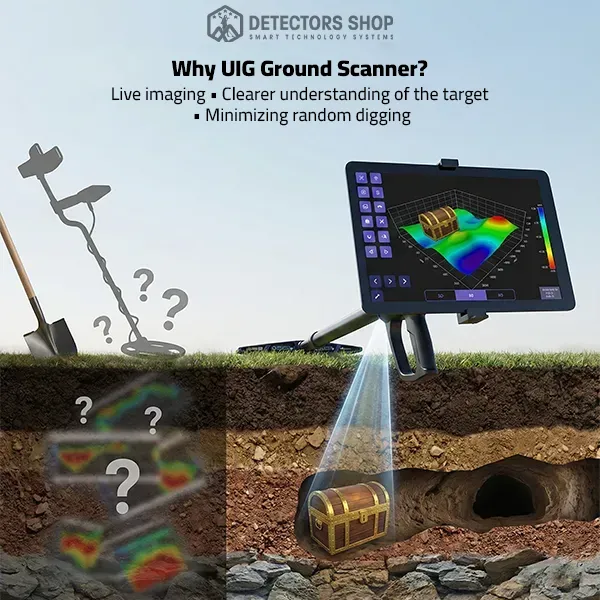
Table of Contents
UIG Ground Scanner Review & Core Highlights
The UIG Ground Scanner stands out as one of the most versatile underground detection systems engineered by GER Detect in Germany. Built with high-grade European quality standards and holding both CE and ISO 9001 certifications, the device is designed to perform reliably across diverse soil environments worldwide, including rocky terrains, mineralized ground, and highly humid conditions.
Unlike traditional metal detectors that rely solely on audio signals, the UIG Ground Scanner integrates advanced multi-sensor signal processing with real-time graphical visualization. By pairing a lightweight, ergonomic multi-tasking imaging sensor with a dedicated multi-language Android tablet, prospectors can identify target depth, size, and metallic composition with extreme accuracy before digging.
Key System Highlights:
- 3 Dedicated Search Technologies: Includes 3D Ground Imaging, Ground Live Scan, and Wall Live Scan.
- 30-Meter Maximum Depth: Detects deeply buried metallic targets, chambers, tunnels, and caves up to 30 meters.
- High-Speed Data Transmission: Uses 2.4 GHz Bluetooth wireless connectivity to stream sensor data seamlessly to the display tablet.
- Multilingual Interface: Fully supports 6 languages: English, Arabic, French, German, Spanish, and Portuguese.
- Acoustic Discrimination: Provides distinct audio alerts for precious metals versus underground voids.
- Ergonomic Design: Features a lightweight telescopic arm and an adjustable grip for effortless field mobility during extended sweeps.
Category Specification Details Manufacturer
| Category | Specification Details |
|---|---|
| Manufacturer | GER Detect (Germany) |
| Certification | European CE Certification & ISO 9001 |
| Search Depth | Up to 30 Meters (98 Feet) in 3D System |
| Detection Technologies | 3D Ground Imaging, Ground Live Scan, Wall Live Scan |
| Data Transmission | Bluetooth 2.4 GHz Radio Frequency |
| Processor Speed | High-Speed 72 MHz Data Processing |
| Supported Languages | English, Arabic, Spanish, French, German, Portuguese |
| Battery Run Time | Up to 10 Hours continuous operation |
| Battery Operating Temperature | 0°C to 50°C |
| Battery Storage Temperature | -5°C to 70°C |
| Charger Operating Temperature | 0°C to 50°C |
| Charger Storage Temperature | -30°C to 80°C |
| Charger Input Voltage | 90 → 250 VAC 50→60 Hz |
| USB Output Current | 5 VDC / 2100 mA |
| Device Weight | 1,100 g |
| Battery Weight | 330 g |
| Empty Bag Weight | 2,230 g |
| Total Package Weight | 3,900 g |
| Bag Dimensions | 635 mm x 335 mm x 145 mm |
| Telescopic Arm Dimensions | Closed: 575 mm – Extended with Sensor: 880 mm |
| Warranty | 5-Year Limited Warranty on Main Unit Electronics |
The 3 Detection Systems Explained
The versatility of the UIG Ground Scanner stems from its three distinct detection modes, allowing users to adapt seamlessly to different search terrains, structural obstacles, and project requirements.
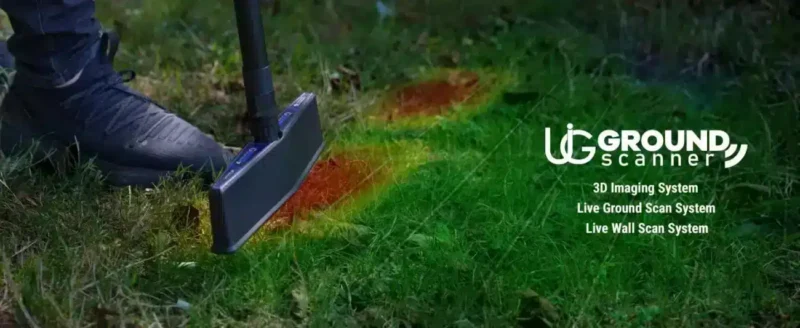
1. 3D Imaging System
This is the primary system for comprehensive subsurface mapping and precise depth measurement up to 30 meters. Designed for full area surveys, it captures data points across a structured grid and generates full-color 3D visual models.
- Configurable Grid Matrix: Users can define grid size from a minimum of 3×3 up to 12 columns (lines) by 12 steps per scan.
- Soil Type Profiling: Features specific calibration presets for Normal, Rocky, Sandy, and Highly Mineralized ground to prevent false signals.
- Scan Trajectory Options: Supports both Parallel movement (one-direction scanning) and Zig-Zag movement (back-and-forth scanning).
2. Ground Live Scan System
The Ground Live Scan mode offers rapid real-time ground tracking without needing to set up a full grid. As the operator walks over the survey line, the tablet continuously updates a dynamic signal graph accompanied by real-time audio indicators:
- Neutral Ground: Displayed as a stable green baseline chart.
- Metallic Targets: Indicated by a rising red chart peak and an elevated signal sound.
- Voids and Caves: Highlighted by a dipping blue chart gradient and a low-frequency tone.
3. Wall Live Scan System
A specialized feature rarely found in standard detectors, the Wall Live Scan mode allows vertical exploration. By shortening the adjustable telescopic arm, prospectors can sweep vertical surfaces, cliff walls, cave interiors, and ancient stone structures. It provides immediate chart and audio discrimination to locate hidden wall cavities, secret rooms, or embedded metallic caches behind masonry.
For More informant you can Download user manual
Advanced 3D Analysis & Display Modes
Once a scan matrix is fully captured using the 3D Imaging System, the software on the Android tablet translates the raw signal data into interactive graphical formats. Operators can utilize three comprehensive display options to analyze targets before initiating excavation:
1. 2D Grid View
Provides a clear top-down view of the scanned area divided into individual square cells corresponding to the lines and steps taken.
- Depth Indicator: Automatically calculates and displays depth estimates for confirmed targets.
- Value Readings: Displays raw signal numbers for each cell to verify signal intensity.
- Color Bar Breakdown: Features a percentage chart quantifying ground mineral levels, metallic targets, and void distributions.
2. Layer Display View
Allows prospectors to slice the subsurface data into distinct geological layers.
- Layer Isolation: Separates metallic target layers, soil layers, salt layers, and cavity layers to eliminate false positives.
- Height Adjustment: Enables increasing or decreasing layer height scale to accentuate small or subtle target signals.
- Full 3D Rotation: Supports 6-axis rotation, allowing users to view the target profile from top, side, and isometric angles.
3. 3D Gradient View
Generates a continuous three-dimensional shape model representing the physical structure of buried items.
- Streamlined Gradient: Smooths color transitions for high-level object shape recognition.
- Sharp Gradient: Highlights distinct boundaries between different soil densities and metallic boundaries.
- Cubic Gradient: Renders targets in geometric cubic blocks, ideal for identifying man-made structures, walls, or chest-like containers.
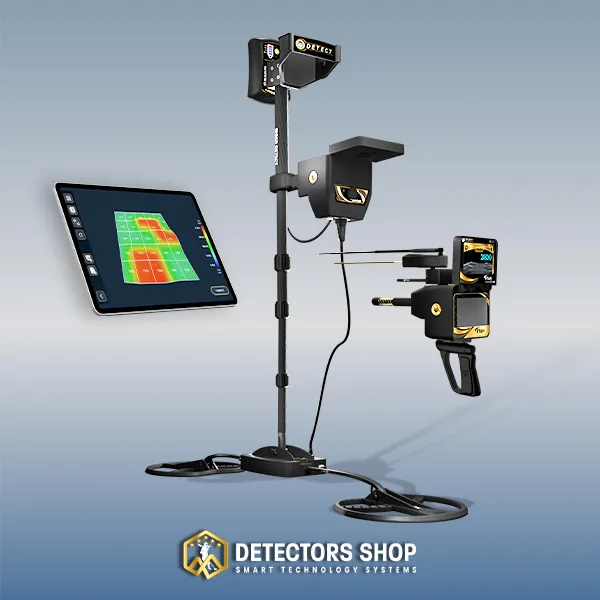
UIG GROUND SCANNER detector | best Scan Technique to find treasure | detectors Shop
Step-by-Step Field Operation Guide
To achieve maximum efficiency and accurate scanning results with the UIG Ground Scanner, operators should follow this systematic field workflow:
1. Physical Assembly
- Attach the multi-tasking imaging sensor securely to the telescoping arm holder.
- Mount the ergonomic handle and lock the tablet stand into place.
- Connect the external 10.8V Li-ion battery pack to the socket located on the arm assembly.
2. System & Bluetooth Setup
- Turn on the battery pack by holding the power button for 2 seconds.
- Launch the Ground Scanner App on the Android tablet.
- Tap the Connect icon and select
UIG-GSto set up Bluetooth pairing (enter1000if prompted for a PIN).
3. Search System & Soil Calibration
- Select your preferred mode (e.g., 3D Imaging System).
- Set the desired grid parameters (Lines: 3 to 12, Steps: 3 to 12).
- Choose your ground profile (Normal, Rocky, Sand, or Mineral) and select your scan path (Parallel or Zig-Zag).
- Hold the unit steady and perform ground calibration by keeping the blue balance indicator centered in the circle.
4. Executing the Scan Grid
- Begin scanning at the starting corner of your grid.
- Press the physical capture button on the handle grip (or tap the tablet screen) at each point.
- Walk forward in uniform steps of 30 cm per capture point.
- Maintain a parallel distance of 30 cm between adjacent scan lines until all steps and lines are completed.
What’s Included in the Box?
When purchasing an original UIG Ground Scanner package, the complete set arrives in a protective, heavy-duty carrying case containing the following components:
- Main Telescopic Sensor Arm: Lightweight adjustable arm with ergonomic grip.
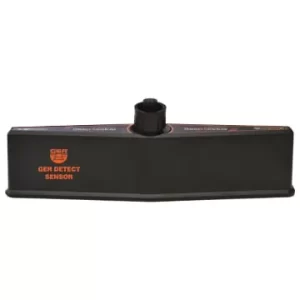
- Multi-Tasking Imaging Sensor: High-precision sensor unit for ground and wall scanning.
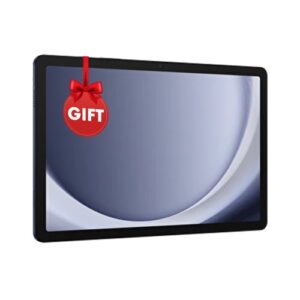
- Android Tablet: Pre-installed with the official multi-language Ground Scanner App.
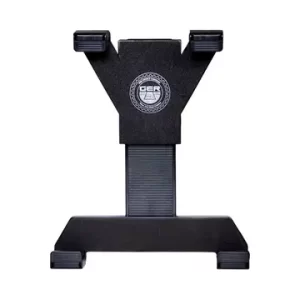
- Tablet Mounting Stand: Secure bracket clip to attach the tablet directly to the arm.
- Rechargeable Battery Pack: External Li-ion battery (10.8V / 27 Wh / 2500 mAh).
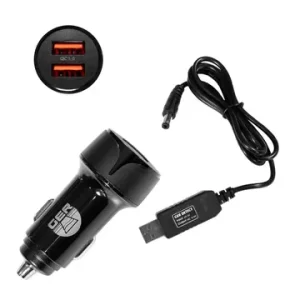
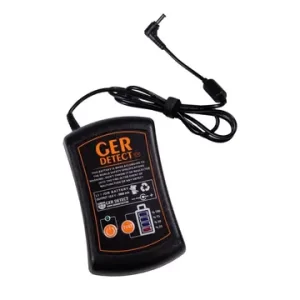
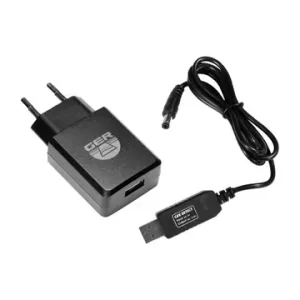
- Power Adapters: Main AC wall charger and DC car charger.
- Heavy-Duty Protective Carrying Case: Padded, impact-resistant travel bag.
Safety & Operational Best Practices
To protect the device hardware and ensure optimal scanning accuracy in the field, keep the following manufacturer guidelines in mind:
- Avoid Wet Conditions: Do not operate the scanner during rain or extreme wet weather; the unit is weatherproof but not fully submersible.
- Prevent Signal Interference: Stay clear of high-voltage energy sources, cell phone towers, and active mobile phones during scanning to eliminate false noise.
- Battery Care: Charge the external battery fully before heading into the field. Always use the original GER Detect charger.
- Warranty Coverage: The main electronic unit includes a 5-year manufacturer warranty covering electronic faults (excludes physical damage from drops, unauthorized opening, battery charger, or tablet).
Final Verdict: Is the UIG Ground Scanner Worth It?
The UIG Ground Scanner by GER Detect is a powerful and versatile underground detection solution for treasure hunters, archaeologists, and professional prospectors. Combining 3D ground imaging, live ground scanning, and specialized wall scanning into a single lightweight unit makes it uniquely equipped to handle diverse search environments—from open fields to caves and ancient structures.
With a 30-meter depth capacity, real-time Bluetooth data transfer, and robust multi-layer 3D analysis tools, the scanner removes much of the guesswork associated with traditional metal detectors. If you require precise target depth estimation, structural cavity location, and target shape modeling prior to excavation, the UIG Ground Scanner delivers exceptional accuracy and long-term reliability backed by German engineering.
For current pricing, package details, availability, training, and the five-year warranty, view the official UIG Ground Scanner page or contact the Detectors Shop team for a professional consultation before purchasing.
Ger Product
-
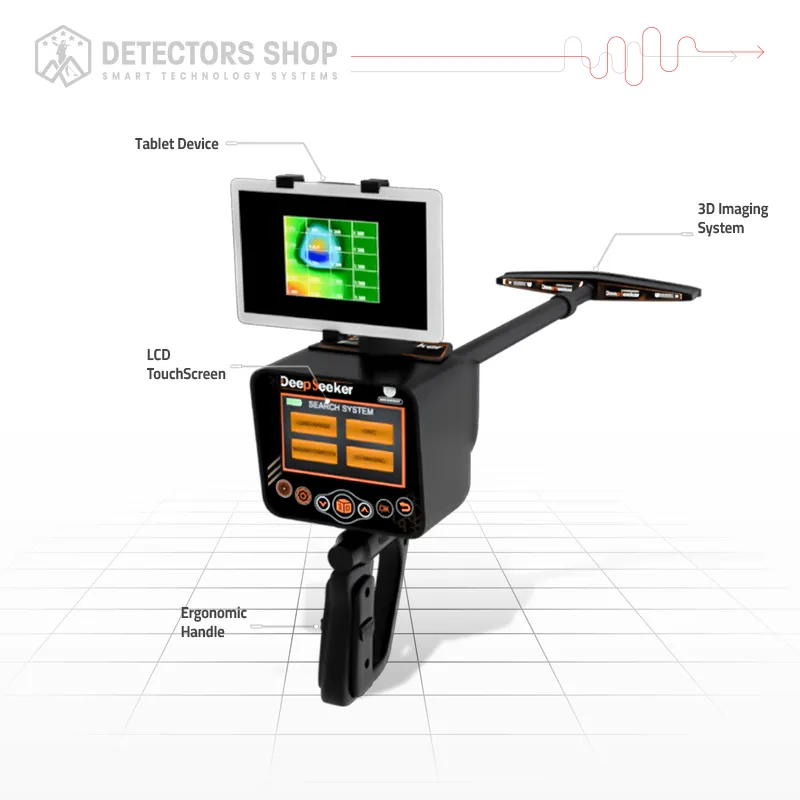
Deep Seeker
$ 5,500 -

Diamond Hunter Smart
$ 2,250 -
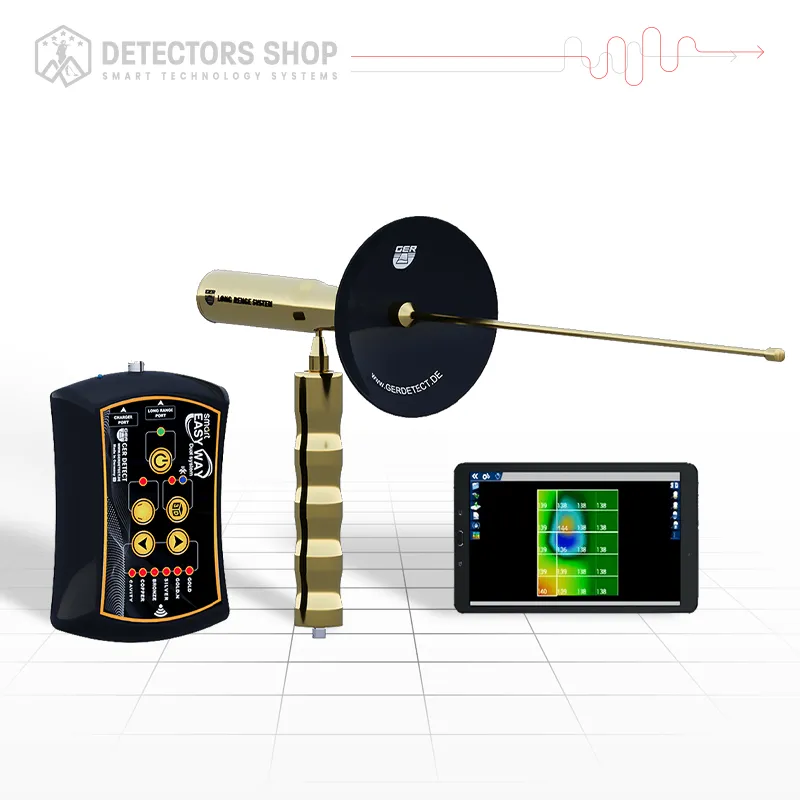
EASY WAY SMART
$ 3,750 -
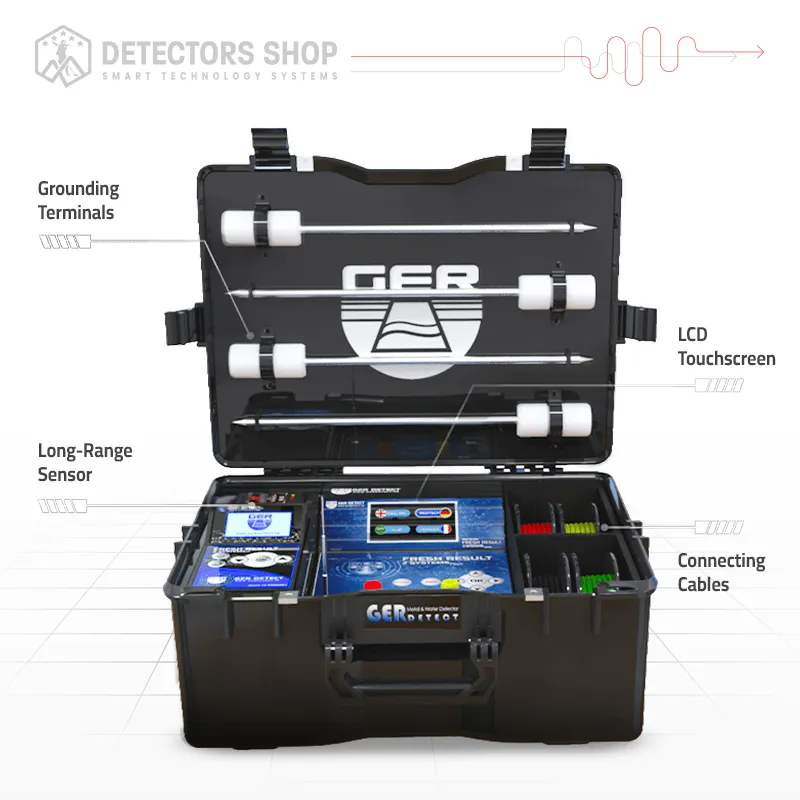
FRESH RESULT 2
$ 5,750 -
Gold Hunter Smart
$ 2,500 -
RIVER G 3
$ 7,000 -
RIVER-F SMART
Original price was: $ 3,000.$ 2,250Current price is: $ 2,250. -
Titan 400 Smart
$ 4,500
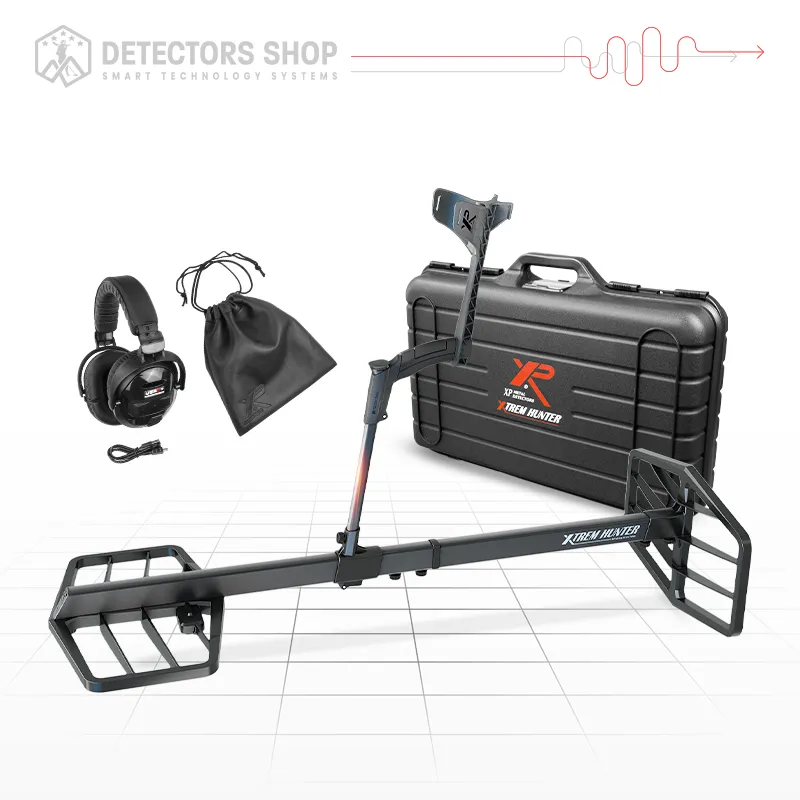
This XP XTREM HUNTER review examines a specialized deep-seeking metal detector designed to locate large metallic objects at depths beyond the practical range of most conventional search coils. Manufactured in France by XP Metal Detectors, the system combines a two-box coil configuration, simultaneous Fast Multi Frequency technology, iron amplitude rejection, and full integration with the wireless DEUS II platform.
According to XP’s official specifications, the XTREM HUNTER can detect appropriately sized metallic targets at depths reaching up to 5 meters under favorable conditions. Its coil geometry is intentionally less responsive to many small objects near the surface, allowing the operator to concentrate on larger and deeper metal masses such as substantial relics, buried containers, metal pipes, tanks, and grouped metallic objects. The complete assembly weighs approximately 2.9 kg with the remote control and is designed to be operated by one person.
Table of Contents
However, the advertised maximum depth should be understood correctly. The XTREM HUNTER is not designed to detect an isolated coin, small piece of jewelry, or tiny gold nugget at five meters. Actual performance depends on target size, metal composition, orientation, soil mineralization, electromagnetic interference, search settings, and the operator’s technique.
This review explains how the XP XTREM HUNTER works, its main settings, compatible components, field workflow, target capabilities, advantages, limitations, and the type of user who will benefit most from this professional deep-searching system.
What Is the XP XTREM HUNTER review?
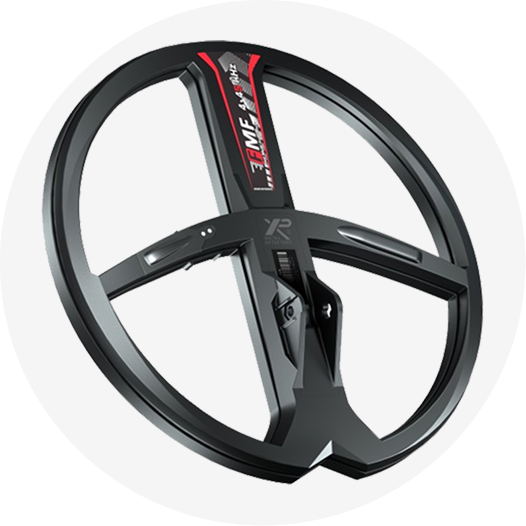
The XP XTREM HUNTER is a professional two-box deep-seeking metal detector built around the wireless DEUS II ecosystem. A front transmitting coil and a rear receiving coil are mounted on a lightweight frame, creating an electromagnetic field designed to respond primarily to larger underground metallic objects.
Unlike a standard metal detector, the operator does not continuously sweep the XTREM HUNTER from side to side close to the ground. Instead, the detector is carried horizontally while the operator walks slowly across the search area. Maintaining a stable height and direction is important for achieving a consistent threshold and recognizing genuine target responses.
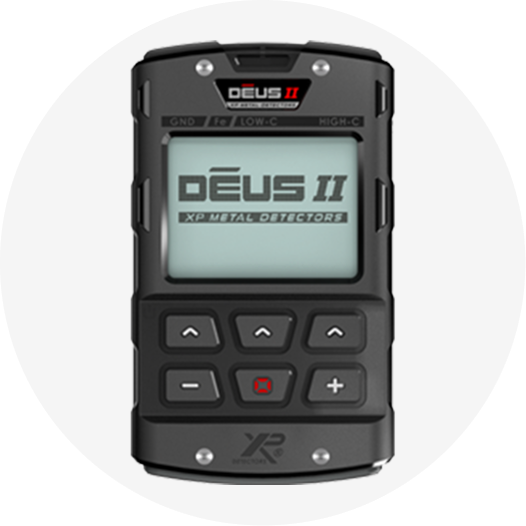
Within the XP ecosystem, the XTREM HUNTER functions as a specialized deep-searching accessory for the DEUS II Remote Control. After pairing it as a new search coil, the remote automatically displays a dedicated XTREM HUNTER interface with controls optimized for wide and deep targets. The user can later switch back to a conventional DEUS II coil to inspect or pinpoint a target detected at a moderate depth.
XP Metal Detectors is a French company based near Toulouse, and the manufacturer states that its products are designed and produced in France.
XP XTREM HUNTER at a Glance
| Specification | XP XTREM HUNTER |
|---|---|
| Manufacturer | XP Metal Detectors |
| Country of manufacture | France |
| Detector type | Two-box deep-seeking metal detector |
| Detection technology | Simultaneous Fast Multi Frequency – FMF |
| Primary target type | Large and deep metallic objects |
| Manufacturer-rated depth | Up to 5 m under suitable conditions |
| Operating method | Non-motion with adjustable Auto Tune |
| Control platform | DEUS II Remote Control |
| Factory programs | 1 factory program |
| Custom programs | 2 user programs |
| Sensitivity | 0–99 |
| Iron discrimination | Disc IAR from OFF to 5 |
| Threshold | 0–20 |
| Reactivity | Levels 1–3 |
| Auto Tune | OFF or levels 1–3 |
| Frequency Shift | 14 bands, automatic or manual |
| Audio Response | Levels 1–4 |
| Ground Balance | Manual or Ground Grab |
| Audio types | Square and Pulse |
| Display | Dynamic four-second signal graph |
| Battery | Rechargeable Li-ion 18650 |
| Battery life | More than 10 hours |
| Charging time | Approximately 4 hours |
| Assembled length | 1.20 m |
| Detector weight with remote | Approximately 2.9 kg |
| Weight inside XP case | Approximately 5.8 kg |
| Carrying case | Rain-resistant and shock-resistant case included |
| Detector warranty | 5 years for parts and labor |
| Battery and connector warranty | 2 years |
These figures are taken from the official XP XTREM HUNTER manual. Package contents may differ according to whether the customer purchases the complete detector set or an accessory package intended for an existing DEUS II owner.
How the Two-Box FMF System Works
Conventional metal detectors are designed to find a broad range of targets, from small coins near the surface to larger metallic objects at greater depths. This versatility can become a disadvantage when the operator is specifically searching for a large, deeply buried object.
Small nails, bottle caps, pieces of wire, and other shallow metal can produce responses that distract the operator or partially mask a larger target underneath. Changes in ground mineralization and unavoidable movement of the coil can also create instability.
The XTREM HUNTER uses widely separated transmitting and receiving coils. The shape and distribution of its electromagnetic field make the detector naturally less sensitive to many small surface objects. This allows it to search through the upper layers of the ground while focusing more strongly on larger metal masses.
XP’s simultaneous FMF platform also helps reduce the instability traditionally associated with older single-frequency two-box detectors. The system is designed to limit ground effects and reduce false signals caused by variations in coil height and movement during walking.
The XTREM HUNTER should not be confused with ground-penetrating radar or a three-dimensional underground scanner. Its screen displays a dynamic representation of the metal-detection signal; it does not produce a photographic image of the buried object or display its exact shape.
XP XTREM HUNTER Detection Depth
XP advertises a maximum detection depth of up to 5 meters, approximately 16.4 feet. That figure applies to sufficiently large metallic targets under appropriate soil and environmental conditions.
Detection depth is not a fixed number. It changes according to:
- Target dimensions and total metallic mass.
- Ferrous or non-ferrous composition.
- Target orientation underground.
- Soil mineralization and moisture.
- Nearby electromagnetic interference.
- Ground Balance, Sensitivity, Reactivity, and Audio Response.
- Search height and walking stability.
- Operator experience.
A large tank, substantial metal pipe, buried container, or concentrated group of metallic objects can produce a detectable response at a much greater depth than an individual coin. Therefore, the five-meter figure should never be interpreted as the expected depth for every target.
Targets the XTREM HUNTER Is Designed to Locate
The detector is suitable for searching for:
- Large buried metallic relics.
- Metal containers and boxes.
- Substantial groups or caches of metallic objects.
- Underground tanks and reservoirs.
- Metal pipes and industrial conduits.
- Large ferrous and non-ferrous objects.
- Significant structural or industrial metal components.
Targets It Is Not Designed For
The XTREM HUNTER is not the correct detector for:
- Individual coins at extreme depths.
- Small jewelry and thin chains.
- Tiny natural gold nuggets.
- Fine gold prospecting.
- Very small surface targets.
- Underground caves or empty spaces without metal.
- Exact identification of a specific metal type.
XP specifically explains that the system is intended for large deep targets and not isolated coins. A grouped mass of coins may generate a response, but an individual coin is outside the detector’s primary purpose.
Iron Discrimination and Small-Target Rejection
One of the XTREM HUNTER’s important features is Disc IAR, or Iron Amplitude Rejection. The adjustment ranges from OFF to level 5.
With Disc IAR switched off, the detector does not attempt to reject ferrous responses. Increasing the setting allows it to classify some ferrous targets according to their signal amplitude and distance from the coils.
The XTREM HUNTER naturally ignores many very small ferrous objects such as nails and bottle caps. Moderately sized iron objects, including items similar in size to tools, horseshoes, or anchors, may be identified with a lower audio tone and a gray or hatched indication on the screen.
Iron rejection is not absolute. A large, unusually shaped, or deeply buried iron target may still produce a response that resembles a non-ferrous object. Excessive IAR in an area containing heavy iron contamination can also mask a larger desirable target. For this reason, promising signals should be checked from more than
DEUS II Compatibility
The XTREM HUNTER requires a compatible DEUS II Remote Control. The remote should be updated to software version 2.0 or later before the XTREM HUNTER is paired.
The pairing process is similar to adding another XP search coil:
- Open the pairing menu on the DEUS II Remote Control.
- Select the coil option.
- Enter the serial numbers supplied with the XTREM HUNTER coils.
- Select the XTREM HUNTER from the available coil list.
- The dedicated deep-search interface will appear automatically.
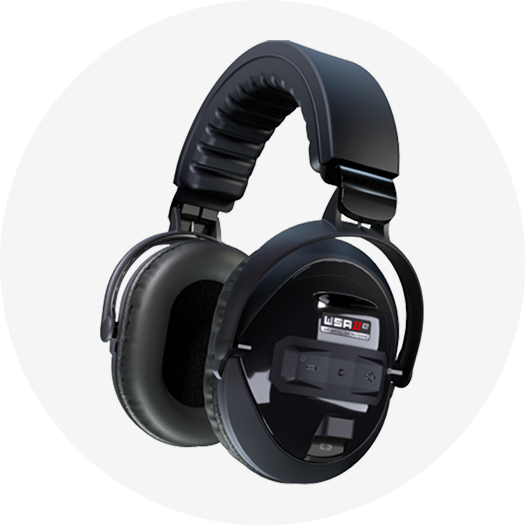
The DEUS I and ORX control platforms are not compatible with the XTREM HUNTER. The WS6, WSA II, and WSA II XL may be used as compatible wireless headphones when correctly updated, but the WS6 module does not replace the DEUS II Remote Control as the main XTREM HUNTER controller.
One practical advantage of the DEUS II ecosystem is the ability to switch quickly between the XTREM HUNTER and a standard DEUS II coil. The operator can locate a broad deep response with the two-box system, mark the area, and then use a conventional coil to inspect the location more precisely when the target is within its practical depth range.
Main XP XTREM HUNTER Settings
| Setting | Function |
|---|---|
| Sensitivity | Controls the overall signal sensitivity. Higher settings may improve weak-target response but can increase instability. |
| Disc IAR | Rejects some ferrous targets according to their signal amplitude and distance from the coils. |
| Threshold | Adjusts the continuous background hum. An excessive threshold can hide faint deep signals. |
| Reactivity | Controls response speed. Lower settings generally favor maximum depth; higher settings improve target localization. |
| Auto Tune | Automatically tracks and adjusts the threshold as ground and environmental conditions change. |
| Frequency Shift | Selects one of 14 channels manually or automatically to reduce EMI. |
| Audio Response | Amplifies weak signals. Higher levels can make deep targets easier to hear but may also amplify ground noise. |
| Ground Balance | Adjusts the detector to the mineralization of the soil using manual adjustment or Ground Grab. |
| Audio Type | Square provides a stable conventional response, while Pulse offers greater sound dynamics for weak deep targets. |
XP recommends performing a Frequency Scan at the beginning of every detecting session. Common Sensitivity settings are normally within the 70–90 range, but difficult or electrically noisy locations may require a lower level.
How to Use the XP XTREM HUNTER
1. Update and Pair the DEUS II Remote
Confirm that the DEUS II Remote Control is running compatible software, then pair the front and rear XTREM HUNTER coils through the coil menu.
2. Assemble and Balance the Detector
Install the front transmitting coil, rear receiving coil, central frame, telescopic stem, handle, support, and carrying strap. Adjust the handle according to the operator’s height so the frame remains comfortable and approximately horizontal.
3. Remove Metallic Objects From the Operator
Phones, keys, belt buckles, steel-reinforced shoes, watches, tools, pinpointers, and backpacks with metal frames can interfere with the detector.
Place these objects well away from the search path. Even a phone carried in a pocket can move relative to the coils and produce misleading variations in the threshold.
4. Choose an Appropriate Test Area
Avoid testing the XTREM HUNTER indoors. Buildings contain electrical wiring, reinforcing steel, pipes, appliances, and other sources of metal and electromagnetic interference.
Whenever possible, search away from:
- Power lines.
- Radio transmitters.
- Houses and industrial buildings.
- Electric fences.
- Large vehicles.
- Underground electrical infrastructure.
5. Perform an Automatic Frequency Scan
Run the automatic Frequency Scan to select the quietest of the 14 available channels. Repeat the scan when moving to a new area or when interference increases.
6. Begin With Stable Settings
A reasonable starting configuration for many sites is:
- Sensitivity: approximately 70–85.
- Reactivity: 1.
- Auto Tune: low or moderate.
- Audio Response: 1 or 2.
- Ground Balance: factory value of approximately 87.
- Disc IAR: OFF or low during initial target confirmation.
These are starting points rather than universal settings. Stability is more valuable than using every setting at its maximum.
7. Maintain a Consistent Search Height
Carry the detector horizontally between approximately knee and hip height. Walk slowly and keep the frame at a consistent distance from the ground.
Raising the detector reduces its response to small shallow objects and can improve stability in contaminated ground. Lowering it too close to the surface may increase responses from unwanted metal and ground variations.
8. Retune the Threshold Regularly
Use the Retune control when the background threshold drifts. When Auto Tune is active, continue moving because holding the detector over a target for too long may cause the system to tune out part of the response.
9. Confirm the Target From Different Directions
A repeatable response is more valuable than a single isolated signal. Mark the apparent center, move away, approach from the opposite direction, and then cross the target at approximately 90 degrees.
Reduce Auto Tune or switch it off temporarily when attempting to identify the precise center of the response.
10. Use a Standard Coil for Final Pinpointing
When the suspected object is within the range of a standard DEUS II coil, switch to that coil and scan the marked location. This can help narrow the excavation area and determine whether shallower metallic material is present.
The official manual provides a similar structured setup and search workflow, including software updating, removing personal metal, Frequency Scan, consistent search height, target confirmation, and switching to a conventional coil when appropriate.
How to Read the XTREM HUNTER Signal Graph
The DEUS II Remote Control displays the most recent four seconds of detector response. The graphical interface gives the operator two main forms of information:
Signal strength can help estimate the relative depth or intensity of the target response.
Signal duration can help indicate whether the target is narrow or extends across a larger area.
A shallow target often produces a double-lobe signal with a negative section between the two peaks. As the same target becomes deeper, the second peak becomes weaker. A substantially deeper target may appear as a single faint but repeatable response.
The graph should be used to compare repeated passes over the same location. It does not display an exact image of the target and should not be treated as a guaranteed depth measurement or metal-identification screen.
Suggested Settings for Different Search Conditions
| Search condition | Suggested approach |
|---|---|
| Clean, low-mineralized ground | Perform Frequency Scan, use Reactivity 1, increase Sensitivity gradually, and use headphones. XP also suggests testing a Ground Balance value near 70 for deep non-ferrous targets in clean ground. |
| Strong electromagnetic interference | Repeat Frequency Scan, reduce Sensitivity to approximately 60–70, lower Audio Response to 1, and move farther from electrical sources. |
| Mineralized or unstable ground | Begin near the default Ground Balance value of 87, use Ground Grab when appropriate, reduce Sensitivity, and maintain a stable frame height. |
| Heavy surface contamination | Raise the frame farther from the ground, reduce Sensitivity to approximately 60–75, lower Audio Response, and avoid excessive iron rejection. |
| Maximum-depth search | Use a low Reactivity setting, walk slowly, use headphones, and increase Sensitivity and Audio Response only while the detector remains stable. |
| Final target localization | Temporarily switch Auto Tune off, increase Reactivity, cross the target from different directions, or use a standard DEUS II coil. |
These recommendations are based on the manufacturer’s operating guidance. The final settings should always be adapted to the actual soil, interference, and target-response stability.
Watch the XP XTREM HUNTER in Action
A practical field video is valuable because the XTREM HUNTER operates differently from a standard metal detector. The video placed in this section should demonstrate:
- Correct assembly and balance.
- Pairing with the DEUS II Remote Control.
- Frequency Scan and initial settings.
- Correct walking height.
- Response to a large buried target.
- Signal graph interpretation.
- Target confirmation from two directions.
- Switching to a standard DEUS II coil.
Watch the XP XTREM HUNTER review field demonstration to see how the two-box FMF system is assembled, balanced, configured, and used to confirm large metallic targets at depth.
What Is Included With the XP XTREM HUNTER?
The standard XTREM HUNTER assembly includes:
- Front coil with wireless transmitter and rechargeable battery.
- Rear receiving coil with connecting cable.
- Two-section XTREM HUNTER frame.
- S-Telescopic stem.
- Adjustable handle and support.
- Carrying strap.
- USB-C charging cable.
- Assembly screws and hardware.
- Rain-resistant and shock-resistant XP carrying case.
- User manual.
The DEUS II Remote Control and wireless headphones may be included or excluded depending on the selected package. Existing DEUS II owners should confirm whether they are purchasing the complete system or the XTREM HUNTER accessory package.
XP XTREM HUNTER Advantages
Strong Focus on Large Deep Targets
The two-box geometry reduces interference from many small surface objects and concentrates the search on substantial underground metal masses.
FMF Stability
Fast Multi Frequency technology improves ground handling and stability compared with the limitations traditionally associated with single-frequency two-box systems.
Practical Iron Rejection
Disc IAR allows the operator to identify or reduce some moderately sized ferrous responses instead of digging every signal.
Lightweight One-Person Design
At approximately 2.9 kg with the Remote Control, the XTREM HUNTER is relatively manageable for a professional two-box detector and does not require two operators.
Wireless DEUS II Integration
The system connects to the DEUS II Remote Control and compatible headphones without a complicated network of control cables.
Useful Signal Display
The four-second dynamic graph helps compare target strength, signal duration, and repeatability.
Long Battery Life
More than ten hours of operating time is sufficient for a full day of field searching under normal conditions.
Five-Year Manufacturer Warranty
XP provides a five-year parts-and-labor warranty for the detector, while batteries and connectors carry a two-year warranty.
XP XTREM HUNTER Limitations
Not Intended for Small Targets
This is not a coin, jewelry, or small-nugget detector. Users searching mainly for small targets will achieve better results with a standard DEUS II configuration.
Maximum Depth Depends on Target Size
The five-meter figure is not applicable to every metallic object. Large targets produce substantially stronger responses than small ones.
Requires the DEUS II Remote Control
The XTREM HUNTER is built around the DEUS II control platform and cannot be operated through DEUS I or ORX.
Sensitive to EMI
The large detecting structure can receive more electromagnetic interference than a small conventional coil, especially near electrical and industrial areas.
Iron Rejection Is Not Perfect
Deep or unusually shaped ferrous objects can still produce uncertain responses. Excavation decisions should not rely on one discrimination setting.
Requires Controlled Movement
Walking speed, search height, frame balance, threshold stability, and repeated confirmation all influence the quality of the result.
Weather-Ready but Not Submersible
The detector is designed to withstand rain and difficult weather, but the XTREM HUNTER assembly should not be submerged. The waterproof rating of the DEUS II Remote Control does not mean the complete two-box frame is suitable for underwater detecting.
Who Should Buy the XP XTREM HUNTER?
The XTREM HUNTER is most suitable for:
- Professional detectorists searching for large deep metal masses.
- Archaeological and historical survey teams.
- Construction and industrial professionals locating tanks or pipes.
- Experienced DEUS II owners who need deeper large-target capability.
- Search teams investigating substantial buried metallic objects.
- Operators who understand that two-box detectors serve a specialized purpose.
It is less suitable for beginners seeking one detector for coins, jewelry, beaches, parks, and natural gold prospecting. Those users will normally benefit more from a conventional DEUS II coil before adding the XTREM HUNTER as a specialized tool.
For more information about XP XTREM HUNTER Download USER Manual From Here
Frequently Asked Questions About the XP XTREM HUNTER
What is the maximum depth of the XP XTREM HUNTER?
XP specifies a maximum depth of up to 5 meters under suitable conditions. Actual depth depends primarily on the dimensions and mass of the target, along with the soil, target orientation, interference, settings, and operator technique.
Can the XTREM HUNTER detect gold?
The XTREM HUNTER detects metallic objects rather than identifying gold specifically. It may respond to a sufficiently large non-ferrous target or concentrated group of metal objects, but it cannot confirm that the detected metal is gold.
Can it find individual coins at five meters?
No. XP states that the XTREM HUNTER is intended for larger deep targets and is not designed to detect isolated coins at extreme depths. A substantial group or cache of coins creates a different target response from one individual coin.
Can the XTREM HUNTER detect caves or voids?
No. It is an electromagnetic metal detector, not a cavity detector, ground-penetrating radar, or underground void scanner. A void would require a different type of detection technology unless it contains a sufficiently large metallic object.
Does the XTREM HUNTER require a DEUS II?
Yes. The system requires a compatible DEUS II Remote Control. Existing DEUS II owners may purchase an accessory package, while new users should select a complete package that includes the required controller.
Is it compatible with DEUS I or ORX?
No. The XTREM HUNTER is designed for the DEUS II platform and is not compatible with DEUS I or ORX.
Can it discriminate iron?
Yes, it includes adjustable Disc IAR from OFF to level 5. It can reject or identify some moderate ferrous targets, but the function does not guarantee perfect separation of all deep iron.
Is the XTREM HUNTER waterproof?
It is designed for rain and challenging weather conditions, but the complete XTREM HUNTER assembly should not be submerged. The DEUS II Remote Control has its own waterproof rating, which applies only to that component.
How long does the battery last?
The official specification lists more than ten hours of battery life, with an approximate charging time of four hours using an appropriate USB charger.
Is the XTREM HUNTER suitable for beginners?
A beginner can learn to use it, but professional instruction is strongly recommended. The detector requires correct balance, stable movement, site preparation, setting adjustment, signal interpretation, and confirmation from multiple directions.
XP XTREM HUNTER Review: Final Verdict
The XP XTREM HUNTER is a specialized deep-seeking metal detector for users who need to locate large buried metallic objects rather than small everyday targets. Its main strengths are its FMF multi-frequency platform, reduced sensitivity to small surface clutter, adjustable iron rejection, DEUS II wireless integration, manageable 2.9 kg weight, and manufacturer-rated depth reaching up to 5 meters on suitable targets.
Its limitations are equally important. The XTREM HUNTER is not intended for isolated coins, small jewelry, tiny gold nuggets, caves, or exact metal identification. It also requires careful control of search height, walking speed, electromagnetic interference, and detector settings.
For archaeologists, industrial users, construction professionals, experienced detectorists, and DEUS II owners who understand the role of a two-box detector, the XTREM HUNTER provides a modern and highly configurable solution for investigating large metallic targets at depth.
Contact Detectors Shop to purchase the original XP XTREM HUNTER with an official warranty, professional training, technical support, and secure worldwide delivery.
Recommended XP Products
Explore compatible XP detectors, search coils, headphones, and accessories.
-
XP ICON X
$ 585 -
XP ICON
$ 550 -
Deus Gold
$ 1,800 -
HF2 Search Coil
$ 400 -
GOLD PAN PREMIUM
$ 165 -
XP GOLD BATEA
$ 145 -
XP GOLD PAN
$ 120 -
XP DEUS II Control
$ 950 -
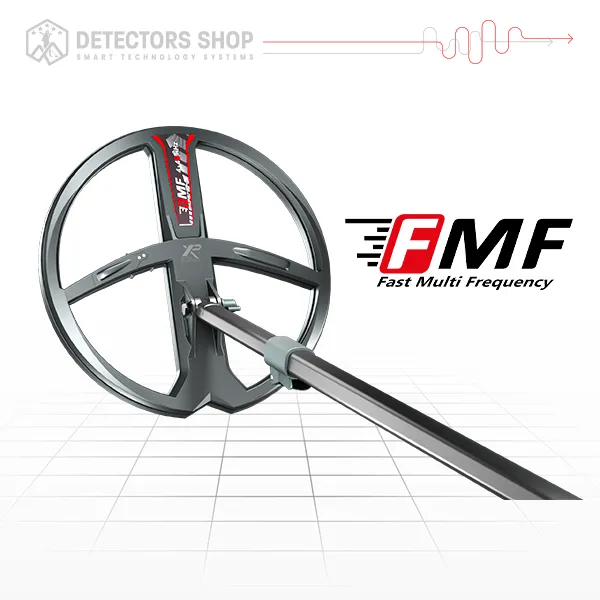
XP 11 FMF Coil
$ 550
This Titan X13 review provides a detailed look at the 11-system professional detector developed by GER Detect for advanced underground exploration. Rather than depending on one search method, the device combines five detection technologies: long-range locating, pulse induction, electromagnetic field detection, magnetometer analysis, and ionic-field detection.
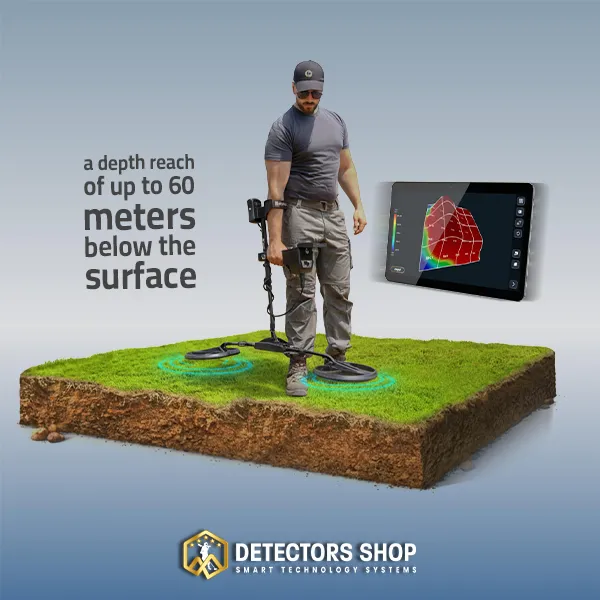
Together, these technologies are designed to help operators search for gold, precious metals, diamonds, gemstones, deeply buried metallic targets, caves, underground voids, and archaeological tombs. According to the manufacturer’s specifications, the Titan X13 can cover areas of up to 3,000 square meters, while its maximum advertised detection depth can reach 60 meters under suitable conditions. Actual results depend on the selected search system, target size and depth, soil conditions, interference, device settings, and operator experience.
In this complete guide, we will explain how all 11 Titan X13 search systems work, what each technology is designed to detect, the correct field workflow, technical specifications, realistic depth considerations, advantages and limitations, package contents, and the five-year warranty provided by Detectors Shop for GER Detect devices.
Table of Contents
What Is the Titan X13 Detector?
The Titan X13 is a professional multi-technology detector developed by GER Detect for investigating a wide variety of underground targets. It integrates 11 specialized search systems into one device, allowing the operator to select a detection method according to the target, terrain, and stage of the search. This makes it considerably different from conventional detectors that depend mainly on a single coil-based search technology.
Its five technology groups serve different purposes during field exploration. The long-range systems help survey wide areas and identify a potential direction, while pulse induction and EMF systems provide direct detection and target analysis. Magnetometer technology is used to investigate magnetic metals and underground voids, the 3D imaging function provides a visual representation of detected anomalies, and the ionic system is designed for long-buried targets. By combining these methods, the Titan X13 allows the operator to move from an initial survey to more focused analysis using one integrated field package.
| Specification | Details |
|---|---|
| Manufacturer | GER Detect |
| Number of Search Systems | 11 specialized systems |
| Detection Technologies | Long-range, pulse induction, EMF, magnetometer, and ionic detection |
| Maximum Advertised Depth | Up to 60 meters under suitable conditions |
| Maximum Coverage Area | Up to 3,000 square meters |
| Supported Targets | Gold, precious metals, diamonds, gemstones, buried metals, caves, voids, and archaeological tombs |
| Metal Selection | 12 selectable metal types |
| Gemstone Selection | 18 selectable gemstone types |
| Interface Languages | Arabic, English, German, French, Spanish, and Persian |
| Warranty | Five years through Detectors Shop for GER Detect devices |
The figures above represent the manufacturer’s maximum specifications. Detection depth and coverage can vary according to the selected system, target characteristics, soil conditions, environmental interference, and operator experience.
Additional technical information is available on the official GER Detect Titan X13 page.
Titan X13 Search Systems Explained
The Titan X13 combines 11 search systems divided across five detection technologies. Each group performs a different role: some systems are intended for surveying large areas, while others provide direct detection, underground analysis, or three-dimensional visualization. Selecting the correct system depends on the target being investigated and the conditions of the search area.
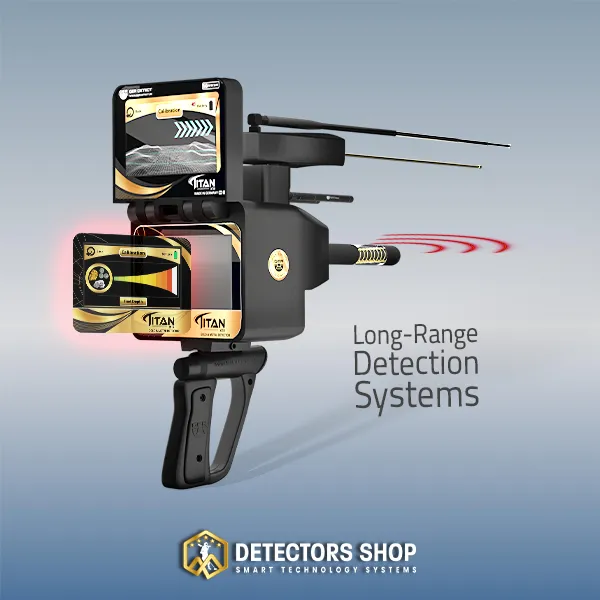
1. Long-Range Detection Systems
The long-range technology group includes four dedicated search systems designed for the initial exploration of large open areas:
- Gold and precious metals detection system
- Diamond detection system
- Gemstone detection system
- Custom long-range search system
According to the manufacturer, these systems can survey areas reaching 3,000 square meters and offer a maximum advertised depth of up to 60 meters under suitable conditions. The operator selects the required target category, surveys the area, and follows the detected direction to progressively narrow the possible target location.
For a more reliable field assessment, directional results should be checked from several positions and then investigated with one of the Titan X13 direct-detection or imaging systems. This structured process helps distinguish a repeatable target indication from environmental interference before any excavation decision is made.
2. Ionic Detection System
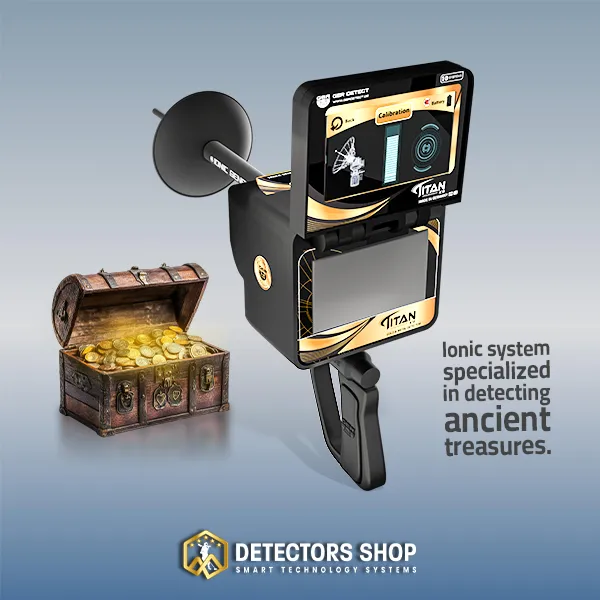
The fifth Titan X13 search system uses ionic-field detection and is specifically intended for investigating ancient metallic targets that have remained underground for long periods. GER Detect describes this system as analyzing ionic-field anomalies that may develop around old buried objects, helping the operator identify areas that require closer examination.
Because the ionic mode is designed for long-buried targets, testing it with a newly buried object does not accurately represent its intended field use. The operator should scan slowly in an open area, observe whether the indication remains consistent, and repeat the search from another direction. Any potential signal should then be verified with a direct-detection, pulse induction, magnetometer, or imaging system before reaching a conclusion.
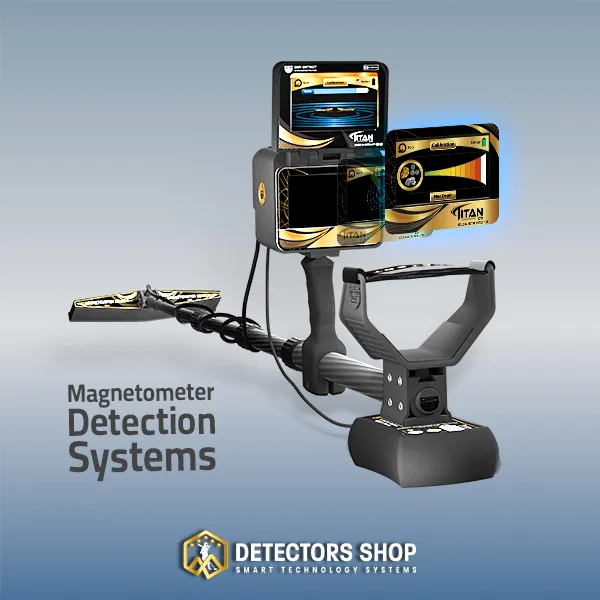
3. Magnetometer Detection Systems
The Titan X13 includes two magnetometer-based search systems that measure variations in the Earth’s magnetic field:
- Void, cave, and archaeological tomb detection system
- Magnetic metal detection system
The first system is designed to locate underground anomalies that may indicate cavities, tunnels, caves, voids, or tomb-like spaces. The second is used to detect buried metallic objects that create a measurable magnetic disturbance, particularly ferrous or magnetic targets.
For an organized survey, the operator should scan the selected area in parallel lines while maintaining a consistent direction, speed, and sensor height. Repeating the scan from another direction helps determine whether an anomaly remains in the same location. Mobile phones, vehicles, power lines, reinforced structures, and nearby metal objects can interfere with magnetic readings, so the search area should be kept as clear as possible. Magnetometer results should be interpreted as underground anomalies and confirmed with another Titan X13 system before excavation.
4. Pulse Induction Detection Systems
The Titan X13 includes two pulse induction systems designed for the direct detection and analysis of buried metallic targets:
- General pulse induction search system
- Advanced pulse induction direct analysis system
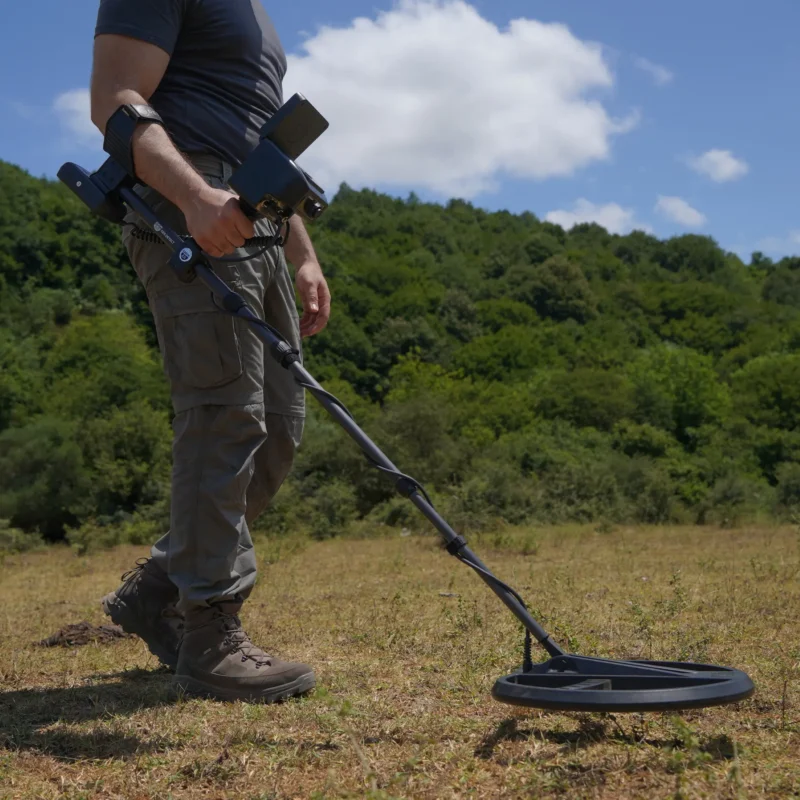
Pulse induction technology operates by transmitting electromagnetic pulses into the ground and analyzing the returning signal produced by a metallic object. The general search system is used to examine the selected area for potential metal responses, while the direct analysis system provides a more focused investigation after the possible target location has been narrowed.
During field use, the search sensor should be moved at a controlled speed and maintained at a consistent height above the ground. A genuine target response should remain concentrated in the same location when the area is scanned from different directions. Signal strength can be affected by target size, burial depth, soil mineralization, nearby metal, and device settings. For better confidence, pulse induction results should be compared with the EMF, magnetometer, or 3D imaging results.
5. EMF Direct Detection and 3D Imaging Systems
The final two Titan X13 systems use electromagnetic field technology for direct underground investigation and visual analysis:
- EMF direct detection system
- EMF-based 3D imaging system
The direct detection system is designed to identify measurable electromagnetic anomalies associated with underground metallic targets or structural changes. After a potential location has been identified, the 3D imaging system allows the operator to scan the area systematically and convert the collected measurements into a visual representation for further analysis.
A three-dimensional scan should be understood as a visualization of recorded sensor data, not as a photographic image of an object beneath the ground. Its accuracy depends heavily on maintaining straight scan lines, consistent spacing, stable sensor height, and controlled movement throughout the survey. Repeating the scan in the opposite direction can help determine whether the anomaly remains stable. The imaging result should then be compared with indications from the pulse induction, magnetometer, or long-range systems before making an excavation decision.
How to Use the Titan X13: Recommended Field Workflow
A structured search process is essential when operating a multi-system detector. The exact procedure may vary according to the target and terrain, but the following workflow provides a practical method for combining the Titan X13 systems:
- Evaluate the search area: Inspect the terrain and identify power lines, vehicles, reinforced structures, surface metal, and other possible sources of interference.
- Select the intended target: Choose the appropriate system for gold, precious metals, diamonds, gemstones, magnetic metals, or underground voids.
- Perform the initial survey: Use the relevant long-range system to examine the wider area and identify a possible target direction.
- Repeat from multiple positions: Conduct the search from different sides of the area. A consistent intersection between repeated directions provides a stronger indication than a single response.
- Mark the potential location: Define a smaller search zone based on the repeated results instead of beginning excavation immediately.
- Apply a direct-detection system: Use pulse induction or EMF for metallic targets, or the magnetometer system when investigating magnetic metals, caves, voids, or tomb-like anomalies.
- Create a detailed scan: When appropriate, scan the narrowed area with the 3D imaging system using consistent lines, spacing, speed, and sensor height.
- Compare all results: A potential target becomes more convincing when two or more independent systems produce repeatable indications in the same location.
Operators should follow the official user manual, complete practical training, and obtain all required permissions before searching or excavating.
How Deep Can the Titan X13 Detect?
According to GER Detect, the maximum advertised detection depth of the Titan X13 can reach up to 60 meters under suitable conditions, with wide-area coverage of up to 3,000 square meters. This maximum figure is primarily associated with long-range surveying and large or deeply buried targets; it does not mean that every target or every search system can reach the same depth.
Actual detection depth depends on several factors:
- Size, shape, and type of the target
- Burial depth and length of time underground
- Soil composition and mineralization
- Moisture and surrounding terrain
- Selected Titan X13 search system
- Device settings and calibration
- Nearby electromagnetic interference
- Operator experience and search technique
A small metallic object will normally be detected at a shallower depth than a large underground structure or concentrated metal mass. For this reason, the 60-meter figure should be treated as a manufacturer-rated maximum rather than a guaranteed result. Reliable field evaluation depends on repeatable signals and confirmation through more than one detection system.
What Can the Titan X13 Detect?
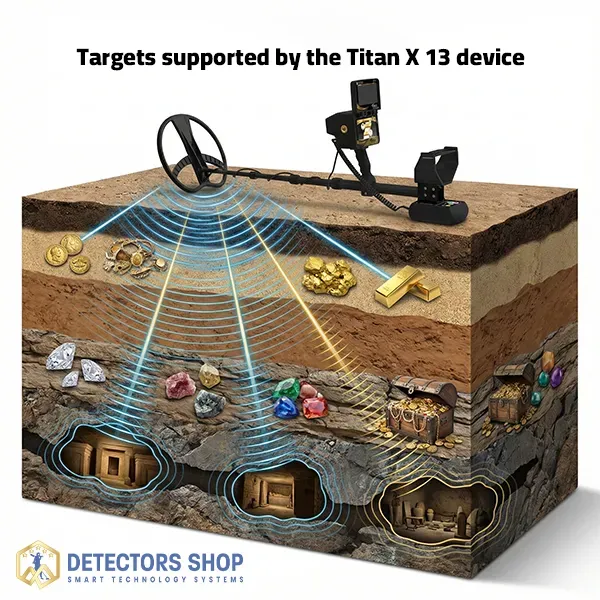
The Titan X13 is designed to investigate several categories of underground targets, including buried gold, raw gold, precious metals, diamonds, gemstones, metallic objects, caves, voids, tunnels, and archaeological tombs. The appropriate target program and detection technology should be selected before beginning the survey.
12 Selectable Metal Targets
The manufacturer lists search options for ancient buried gold, raw gold, platinum, silver, mercury, bronze, lead, copper, cobalt, lithium, coltan, and meteorite stones.
18 Selectable Gemstone Targets
The gemstone programs include ruby, emerald, quartz, topaz, agate, amethyst, lapis lazuli, tourmaline, columbite, tanzanite, turquoise, peridot, alexandrite, cat’s eye, sapphire, jasper, opal, and aquamarine.
Target selection helps configure the device for the intended search category, but it should not be interpreted as laboratory-grade material identification. A field indication must remain consistent when the scan is repeated and should be verified through another suitable Titan X13 system. The magnetometer and imaging functions can also be used to investigate underground anomalies associated with caves, voids, tunnels, and tomb-like structures.
Titan X13 Advantages and Limitations
A balanced Titan X13 review must consider both the flexibility of its multi-system design and the practical requirements of operating it correctly.
Main Advantages
- Eleven search systems combined in one professional package
- Five detection technologies for different targets and search stages
- Search programs for metals, diamonds, gemstones, caves, and voids
- Wide-area surveying followed by direct detection and 3D analysis
- Manufacturer-rated coverage of up to 3,000 square meters
- Maximum advertised depth of up to 60 meters under suitable conditions
- Interface support for six languages
- Ability to compare results from multiple independent systems
- Five-year Detectors Shop warranty for GER Detect devices
Important Limitations
- The number of systems creates a learning curve and requires proper training
- Maximum depth and coverage figures cannot be guaranteed in every location
- Environmental interference and incorrect settings can produce misleading signals
- Each system has a specific purpose and cannot detect every target equally
- Three-dimensional results require careful scanning and experienced interpretation
- The price is considerably higher than that of a simple single-purpose detector
The Titan X13 offers its greatest value when the operator understands how to select, combine, and verify its different systems. It is not intended as a simple recreational detector that can be operated effectively without preparation or field practice.
Who Should Buy the Titan X13?
The Titan X13 is best suited to professional exploration teams, experienced operators, and serious users who need several detection technologies in one device. It is particularly relevant for projects that begin with wide-area surveying and require additional systems for direct detection, void investigation, target analysis, and 3D visualization.
A serious beginner can also use the device after receiving proper training and learning the purpose of each system. However, the Titan X13 may not be the right choice for someone seeking an inexpensive recreational detector, simple coin hunting, or basic plug-and-play operation. Its value comes from combining multiple systems correctly and comparing their results during organized fieldwork.
Titan X13 Price, Warranty, and Support
At the time of publication, the Titan X13 price listed by Detectors Shop is US$13,000. Because prices, shipping arrangements, and available offers may change, buyers should check the official Titan X13 product page or contact the sales team for the latest information before ordering.
GER Detect devices purchased from Detectors Shop include a five-year warranty. Customers also receive professional device training, technical guidance, and after-sales support to help them understand the different search systems and operate the detector correctly. This support is particularly valuable for a device with 11 specialized systems and several field configurations.
Frequently Asked Questions About the Titan X13
How many search systems does the Titan X13 have?
The Titan X13 combines 11 specialized search systems across five technologies: long-range detection, ionic detection, magnetometer analysis, pulse induction, and EMF detection with 3D imaging.
How deep can the Titan X13 detect?
According to GER Detect, the Titan X13 has a maximum advertised detection depth of up to 60 meters under suitable conditions. Actual depth depends on the target, soil, selected system, settings, and operator experience.
What targets can the Titan X13 detect?
The Titan X13 is designed to search for gold, precious metals, diamonds, gemstones, buried metallic objects, caves, underground voids, tunnels, and archaeological tombs.
Can the Titan X13 detect caves and underground voids?
Yes. The device includes magnetometer and EMF-based systems designed to investigate underground anomalies associated with caves, voids, tunnels, and tomb-like structures.
Is the Titan X13 suitable for beginners?
The Titan X13 can be used by serious beginners after proper training. Because it includes 11 search systems, operators must understand the purpose and correct settings of each technology.
Does the Titan X13 produce real 3D underground images?
The 3D system converts recorded sensor measurements into a visual representation of underground anomalies. It does not produce a photographic image of an object beneath the ground.
What is the Titan X13 price?
At the time of publication, the Titan X13 price is US$13,000. Check the official Detectors Shop product page for current pricing, availability, and shipping information.
What warranty is included with the Titan X13?
The Titan X13 includes a five-year warranty from Detectors Shop for GER Detect devices, together with professional training, technical guidance, and after-sales support.
Titan X13 Review: Final Verdict
This Titan X13 Review shows that the device’s greatest advantage is not simply its maximum depth specification, but its ability to combine several detection methods during one organized investigation. The operator can begin with wide-area surveying, narrow the potential location, apply direct detection, investigate metal or void anomalies, and analyze the selected area with 3D imaging.
The Titan X13 is best suited to professional teams and serious users who require multiple technologies and are prepared to complete proper training. Its results still depend on terrain, target characteristics, settings, interference, and operator experience, making repeated scans and confirmation through more than one system essential.
For current pricing, package details, availability, training, and the five-year warranty, view the official Titan X13 product page or contact the Detectors Shop team for a professional consultation before purchasing.
This Titan 500 Smart review provides a practical and detailed look at a professional long-range detector designed for searching gold, precious metals, diamonds, gemstones, and other underground targets. The device combines multiple search systems, adjustable field settings, and a color touchscreen interface to support structured field exploration across large areas.
In this guide, you will learn what the Titan 500 Smart is, how its four search systems work, how to use it step by step, what comes in the package, and which field factors affect its actual performance.
According to the manufacturer’s specifications, the Titan 500 Smart offers a forward search range from 100 to 3,000 meters and a maximum advertised detection depth of up to 120 meters under suitable conditions. Actual performance can vary depending on the target size, soil composition, terrain conditions, mineralization, electromagnetic interference, and operator experience.
With multiple search modes, field-adjustable settings, six interface languages, and a portable design for practical outdoor use, the Titan 500 Smart is intended for users who need more than a basic detection device. This article explains its systems, technical specifications, operating method, package contents, practical advantages, and the most important points to consider before buying.
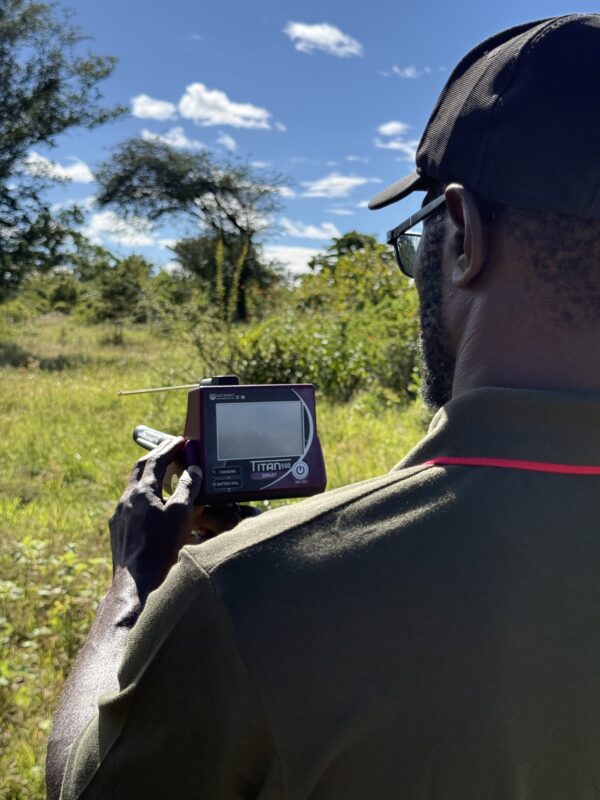
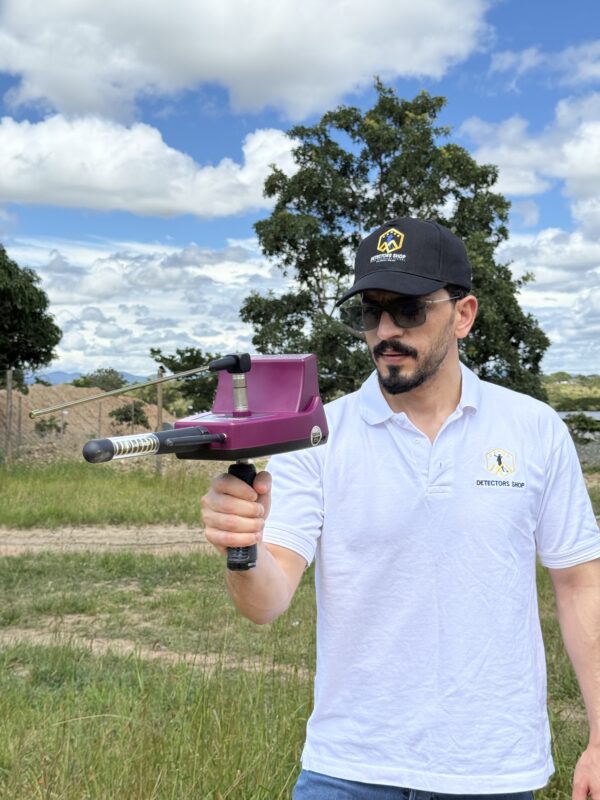
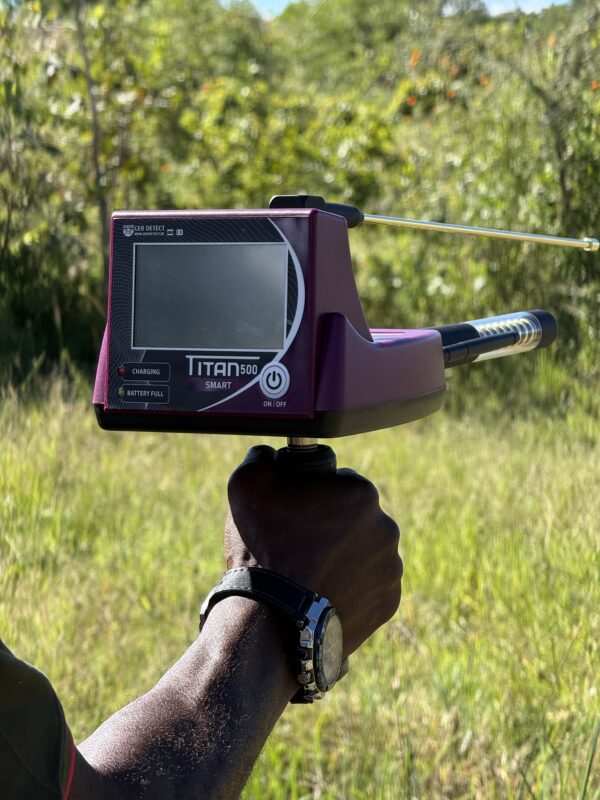
Table of Contents
What Is the Titan 500 Smart Detector ?
The Titan 500 Smart is a professional long-range detection system developed for searching for gold, precious metals, diamonds, gemstones, and other underground targets across large areas. According to the manufacturer’s manual, the device combines multiple target-specific search functions with adjustable range settings, depth analysis, and a color touchscreen interface designed for structured field exploration.
The Titan 500 Smart supports searches for large and small diamonds, 18 types of gemstones, and a range of precious and non-ferrous metals. The manufacturer also specifies a forward search range of up to 3,000 meters and a maximum advertised depth of up to 120 meters under suitable conditions.
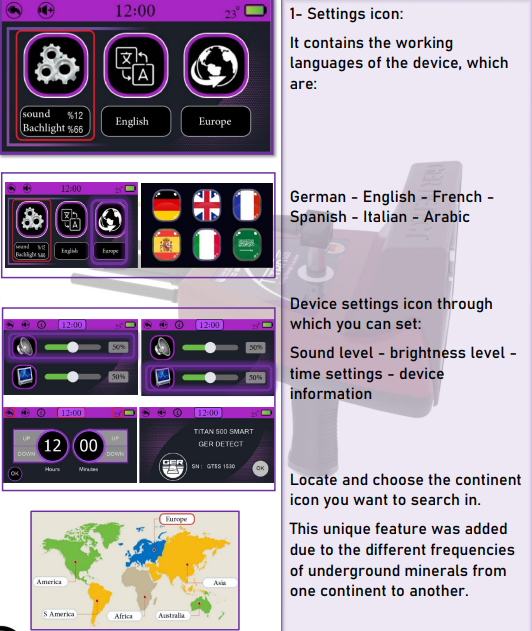
The device operates in six languages — German, English, French, Spanish, Italian, and Arabic — and includes regional settings intended to adapt the search process to different countries and environments.
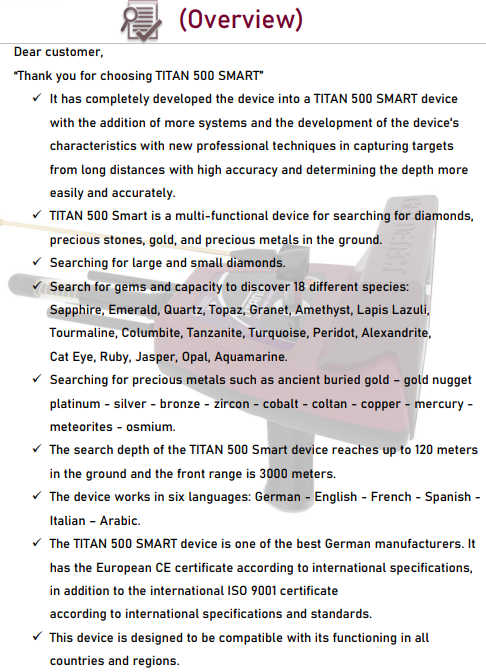
Titan 500 Smart Specifications at a Glance
Before examining each search system in detail, this table provides a concise overview of the Titan 500 Smart specifications, including its search systems, supported targets, operating range, display, battery performance, languages, and package details.
According to the manufacturer, the maximum advertised detection depth is up to 120 meters and the selectable forward search range extends from 100 to 3,000 meters. Actual field performance can vary depending on target size, soil conditions, mineralization, interference, device settings, and operator experience.
| Specification | Details |
|---|---|
| Brand | GER Detect |
| Country of manufacture | Country / origin: Germany |
| Search systems | 4 professional systems |
| Main targets | Gold, precious metals, diamonds and gemstones |
| Maximum search depth | Up to 120 meters, manufacturer-rated |
| Selectable forward range | From 100 to 3,000 meters |
| Display | Full-color LCD touchscreen, 480 × 272 px |
| Operating languages | Arabic, English, German, French, Italian and Spanish |
| Operating frequency | 3.2–18 kHz |
| Battery runtime | Up to 10 hours |
| Total package weight | Approximately 4.865 kg |
| Water protection | Not waterproof; avoid rain and direct water exposure |
| Warranty | 5 years through Detectors Shop |
Titan 500 Smart Technical Specifications
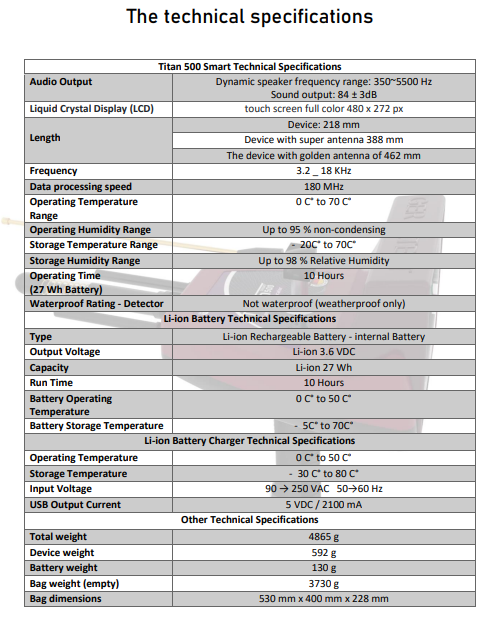
The following technical specifications are taken from the Titan 500 Smart operating manual and provide a detailed reference for the device, battery, charger, dimensions, operating conditions, and weight.
| Specification | Details |
|---|---|
| Display | Full-color LCD touchscreen, 480 × 272 px |
| Operating Frequency | 3.2–18 kHz |
| Data Processing Speed | 180 MHz |
| Maximum Search Range | Up to 3,000 meters |
| Maximum Advertised Detection Depth | Up to 120 meters |
| Audio Output | Dynamic speaker, 350–5500 Hz |
| Sound Output | 84 ± 3 dB |
| Device Length | 218 mm |
| Device Length with Super Antenna | 388 mm |
| Device Length with Golden Antenna | 462 mm |
| Operating Temperature | 0°C to 70°C |
| Operating Humidity | Up to 95% non-condensing |
| Storage Temperature | -20°C to 70°C |
| Storage Humidity | Up to 98% relative humidity |
| Battery Type | Internal rechargeable Li-ion battery |
| Battery Output Voltage | 3.6 VDC |
| Battery Capacity | 27 Wh |
| Battery Runtime | Up to 10 hours |
| Battery Operating Temperature | 0°C to 50°C |
| Battery Storage Temperature | -5°C to 70°C |
| Water Protection | Not waterproof; weather-resistant only |
| Charger Operating Temperature | 0°C to 50°C |
| Charger Storage Temperature | -30°C to 80°C |
| Charger Input Voltage | 90–250 VAC, 50–60 Hz |
| USB Output | 5 VDC / 2100 mA |
| Total Package Weight | 4,865 g |
| Device Weight | 592 g |
| Battery Weight | 130 g |
| Empty Case Weight | 3,730 g |
| Protective Case Dimensions | 530 × 400 × 228 mm |
The Four Titan 500 Smart Search Systems Explained
Titan 500 Smart combines four specialized search systems within one touchscreen-controlled platform. Each system is designed for a specific target category or a specific stage of the search process, allowing the operator to move from wide-area directional surveying to target confirmation and depth estimation without changing devices.
The four systems cover gold and precious metals, gemstones, diamonds, and depth determination with result analysis. The operator can select the appropriate system according to the target being searched for, then adjust the search settings and forward range before beginning the field survey.
1-Gold and Precious Metals Detection System
The Gold and Precious Metals Detection System is designed for long-range directional searches across large areas. It allows the operator to select a specific metallic target before beginning the search, helping narrow the detection process according to the material being investigated.
According to the Titan 500 Smart operating manual, selectable targets include ancient buried gold, gold nuggets, platinum, silver, bronze, zircon, cobalt, coltan, copper, mercury, meteorites, osmium, and other valuable metallic targets.
Before starting the search, the operator selects the target type, continent or region, soil conditions, and forward search range. The device then begins the directional search based on the selected settings and guides the operator toward a potential target location.
For more reliable results, the indicated direction should not be accepted from a single pass. The operator should approach the suspected target area gradually and confirm the signal from multiple directions before moving to the depth-analysis stage.
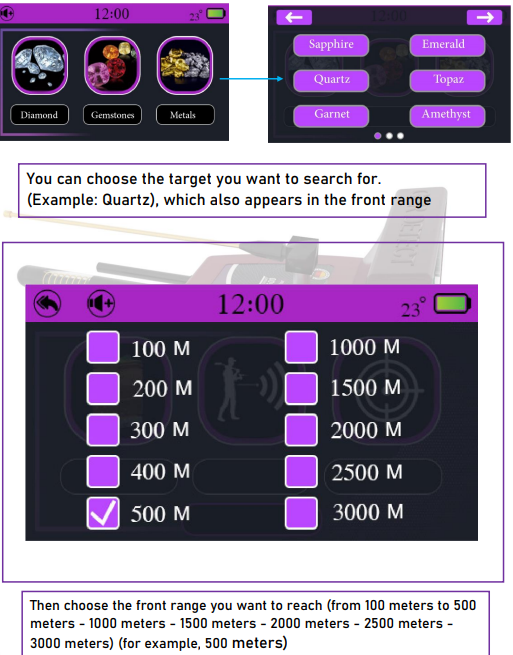
2.Gemstone Detection System
The Gemstone Detection System is designed for directional searches targeting specific gemstones underground. Before beginning the search, the operator selects the gemstone type and the forward search range according to the expected target and size of the survey area.
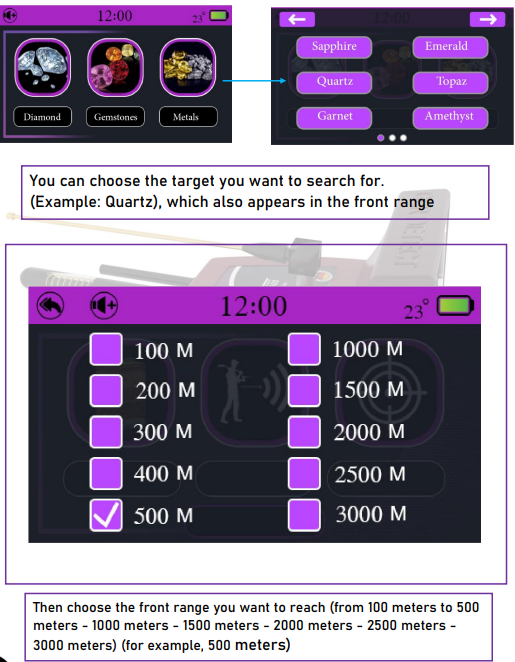
According to the Titan 500 Smart operating manual, the system supports 18 gemstone categories: sapphire, emerald, quartz, topaz, garnet, amethyst, lapis lazuli, tourmaline, columbite, tanzanite, turquoise, peridot, alexandrite, cat’s eye, ruby, jasper, opal, and aquamarine.
Once the target type is selected, the device begins scanning according to the chosen settings. Any indicated direction should be approached gradually and verified through repeated passes rather than relying on a single response.
Field conditions can affect the stability of the result, so the operator should maintain correct device balance and avoid sources of interference such as nearby electronics, communication networks, surface metals, and power sources.
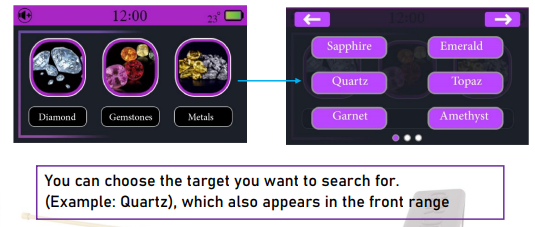
3. Diamond Detection System
The Diamond Detection System is designed for directional searches focused specifically on diamond targets. According to the Titan 500 Smart operating manual, the device is intended to search for both large and small diamonds underground.
Before beginning the search, the operator selects the diamond target profile and the desired forward search range according to the size of the survey area. The device then begins scanning based on the selected settings and indicates a potential target direction.
As with the other search modes, the result should be confirmed through repeated passes from different positions rather than relying on a single signal. The operator should maintain proper device balance and minimize nearby sources of electromagnetic interference during the search.
Once a consistent target direction has been confirmed, the operator can proceed to the depth-analysis stage to estimate the likely target depth and evaluate the result more carefully.
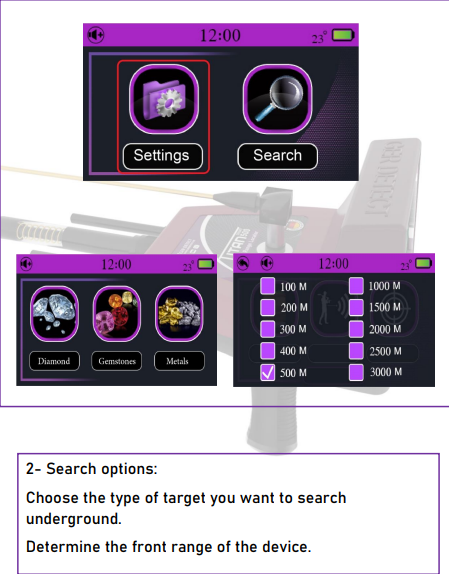
4- Depth Determination and Result Analysis System
The Depth Determination and Result Analysis System is used after the operator has identified and confirmed a potential target location from multiple directions.
After marking the suspected target center, the operator moves at least two meters away, points the balanced device toward the target, and starts the depth-analysis procedure. The operator then walks toward the marked point until the device indicates that the target has been passed.
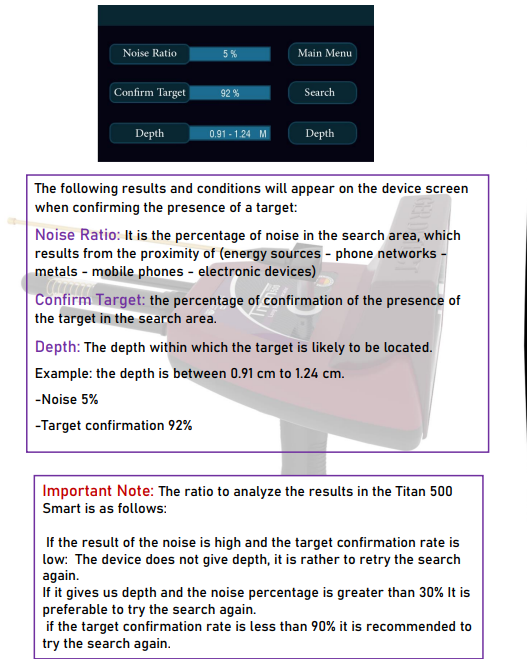
The process is repeated from the opposite direction. After analyzing both passes, the Titan 500 Smart displays the estimated target depth together with the target-confirmation percentage and the surrounding noise ratio.
The operating manual recommends repeating the search when the noise ratio exceeds 30% or when the target-confirmation rate is below 90%. Nearby power sources, mobile phones, communication networks, electronic equipment, and surface metals can increase interference and affect the stability of the result.
The displayed depth should therefore be treated as a field estimate and confirmed through repeated, consistent scans before making an excavation decision.
Titan 500 Smart Review How to Use the Titan 500 Smart Step by Step
Correct setup and a consistent search procedure are essential for obtaining stable Titan 500 Smart readings. The following operating sequence is based on the official user manual.
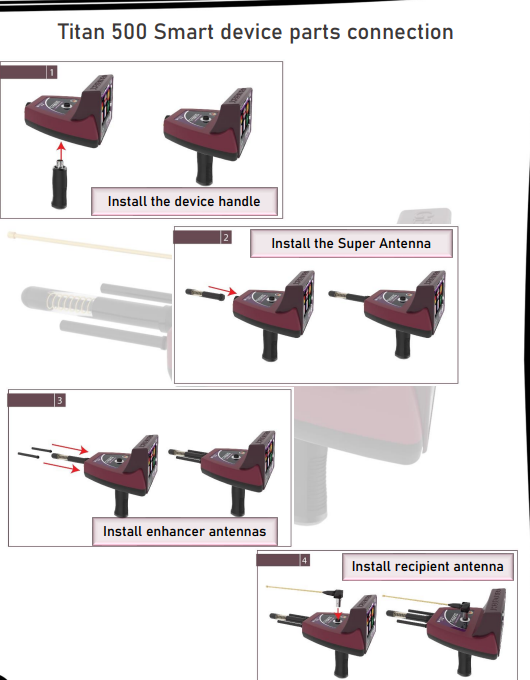
- Assemble the device
Install the device handle, Super Antenna, enhancer antennas, and recipient antenna. Make sure all parts are correctly connected before turning on the device.
- Check the battery and search environment
Make sure the battery is fully charged before beginning the search. Avoid operating the device in rain, and keep mobile phones, electronic equipment, communication networks, power sources, and nearby surface metals away from the search area whenever possible.
- Turn on the Titan 500 Smart
Press and hold the power button for approximately two seconds. After startup, the main screen displays the battery level, clock, temperature, sound controls, language settings, and other operating options.
- Select the language and region
Choose the preferred operating language and select the continent or region in which the search will be performed. The device supports German, English, French, Spanish, Italian, and Arabic.
- Select the target type
Open the search options and choose the target category you want to investigate. Depending on the selected system, the device provides target options for diamonds, gemstones, gold, precious metals, and other supported materials.
- Set the forward search range
Select the forward search range according to the size of the survey area. Available settings extend from 100 meters up to 3,000 meters.
When the approximate target area is already known, using a shorter range can make the search process more focused. When surveying a large unknown area, a longer range can be selected.
- Start the search
Press the Search button to begin scanning with the selected target, range, and regional settings.
During the search, keep the device balanced and follow the directional response shown on the display. As the device receives a potential target signal, the directional indication and audio response help guide the operator toward the suspected location.
- Confirm the target direction
Do not rely on the first signal alone. Approach the suspected location and confirm the target from multiple directions.
The manual recommends checking the location from north to south, south to north, west to east, and east to west. This process helps narrow the search area and identify the likely center of the target.
- Mark the target center
After repeated directional confirmation, mark the suspected target center. When the device passes the target and changes direction, use the repeated passes to refine the marked location.
- Perform the depth analysis
After confirming the target location, activate the depth function. Move at least two meters away from the marked center, point the balanced device toward the target, and begin the depth procedure.
Walk toward the marked point until the device indicates that the target has been passed. Repeat the procedure from the opposite direction so the system can analyze both passes.
- Review the final result
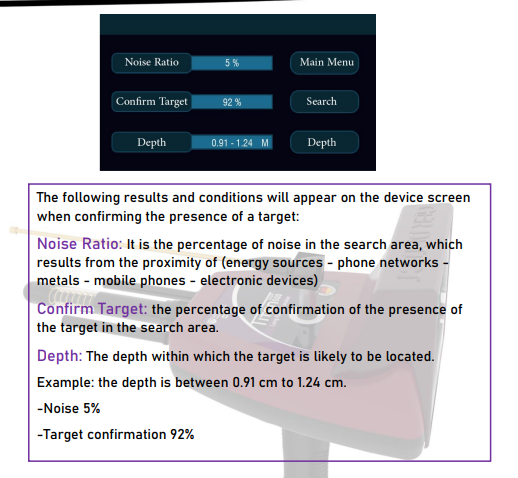
The Titan 500 Smart can display:
Noise Ratio
Target Confirmation
Estimated Depth
If the noise ratio is above 30%, the manual recommends repeating the search. The search should also be repeated when target confirmation is below 90%.
The depth result should be treated as an estimate and confirmed through several consistent scans before making an excavation decision.
Titan 500 Smart Video Demonstration
Watch this Titan 500 Smart video demonstration for a closer look at the device, its design, supported targets, and operating features.
Can the Titan 500 Smart Detect Up to 120 Meters Deep?
According to the manufacturer’s specifications, the Titan 500 Smart has a maximum advertised detection depth of up to 120 meters under suitable conditions.
This figure should not be treated as a guaranteed depth for every target. Actual performance can vary depending on the target size, burial period, soil composition, mineralization, electromagnetic interference, selected settings, and operator experience.
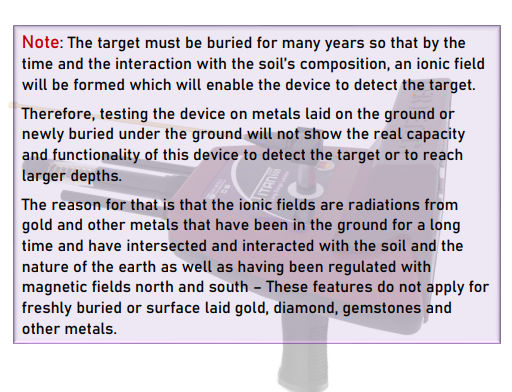
The official operating manual also explains that freshly buried or surface-laid targets are not suitable for demonstrating the device’s full long-range capability. The system is designed to work with targets that have remained underground long enough to interact with the surrounding soil and environment.
The selectable forward search range extends from 100 to 3,000 meters. Shorter ranges are more suitable when the approximate search area is already known, while longer ranges are intended for preliminary surveys across larger open areas.
For more reliable field results, the operator should confirm the target direction through repeated scans from multiple positions before using the depth-analysis system. High interference or unstable readings can reduce the accuracy of target confirmation and depth estimation.
What Is Included with the Titan 500 Smart?
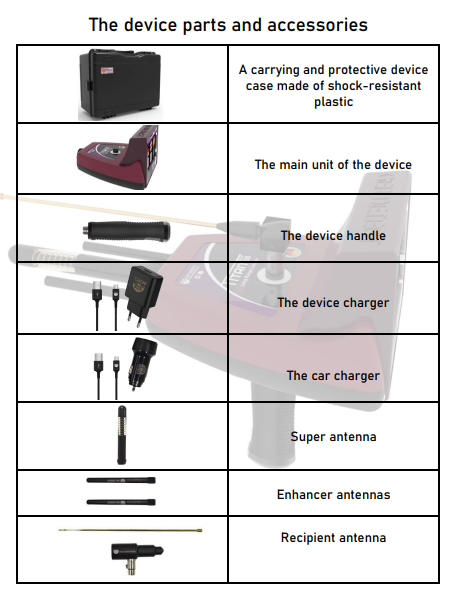
The Titan 500 Smart package includes the main detection unit, device handle, Super Antenna, enhancer antennas, recipient antenna, home charger, car charger, and a shock-resistant carrying and protective case.
The main unit weighs approximately 592 grams, while the complete package weighs about 4.865 kilograms. The rechargeable internal battery provides up to 10 hours of operating time under normal conditions.
The protective case is designed to make transportation between field locations easier and to protect the system during storage and travel.
The detector itself is not waterproof and should not be operated in rain or exposed directly to water. Users should also make sure the battery is fully charged and all parts are correctly connected before beginning fieldwork.
Customers purchasing the Titan 500 Smart through Detectors Shop also receive a five-year warranty, professional operating training, and technical support.
Who Is the Titan 500 Smart Best For?
Titan 500 Smart is best suited to serious prospectors, exploration teams, and buyers who need to survey large areas for gold, precious metals, diamonds, or gemstones. It can also be suitable for committed beginners who are willing to complete professional training and learn the correct confirmation process. It is not designed as a simple recreational detector for quickly testing surface objects or recently buried targets.
Main Advantages
- Four specialized search systems in one device
- Selectable forward range from 100 to 3,000 meters
- Target direction, confirmation and depth-analysis functions
- Full-color touchscreen with six operating languages
- Lightweight main unit and protective carrying case
- Up to 10 hours of battery operation
- Five-year Detectors Shop warranty and professional training
Important Considerations
- Maximum depth and range are not guaranteed in every environment
- Correct settings and repeated directional confirmation are essential
- Electrical interference and mineralized soil can affect results
- Freshly buried objects are not suitable for evaluating full performance
- The device is not waterproof and should only be used in dry conditions
Frequently Asked Questions About the Titan 500 Smart
What targets can the Titan 500 Smart detect?
The device includes selectable systems for gold, precious metals, diamonds, gemstones, and depth analysis of potential underground targets.
What is the maximum advertised detection depth?
The manufacturer rates the maximum search depth at up to 120 meters under suitable conditions. Actual depth varies according to the target, soil, interference, settings, and operator experience.
What is the forward search range?
The operator can select a forward range between 100 and 3,000 meters according to the size of the search area.
Is the Titan 500 Smart suitable for beginners?
Yes, it can be used by serious beginners after receiving proper training. Understanding device balance, target confirmation, and field interference is essential.
Is the Titan 500 Smart waterproof?
No. The detector is not waterproof and should not be used during rain or exposed directly to water.
What warranty does Detectors Shop provide?
Detectors Shop provides a five-year warranty for the Titan 500 Smart, together with professional operating training and technical support.
Titan 500 Smart Detector Price at Detectors Shop
The Titan 500 Smart Detector price is currently $4,000 at Detectors Shop.
The device is supplied with its main accessories, warranty, professional product support, and international shipping options. The final cost may vary depending on the destination country, shipping method, and current availability.
Customers can contact Detectors Shop to confirm the latest Titan 500 Smart price, stock availability, and delivery options before placing an order.
When comparing the Titan 500 Smart Detector price with other professional long-range detection systems, it is important to consider the included search systems, adjustable search range, depth-analysis functions, warranty, training, and after-sales support rather than comparing the device by price alone.
Final Verdict: Is the Titan 500 Smart Worth Buying?
The Titan 500 Smart is a versatile long-range detection system that combines four target-specific search systems, adjustable search distances, touchscreen operation, and depth analysis within one portable platform.
Its main advantage is the ability to survey large areas and progressively narrow a potential target location through a structured process of target selection, directional scanning, repeated confirmation, and depth estimation.
For trained users searching for gold, precious metals, diamonds, and gemstones, the Titan 500 Smart offers a strong combination of target selection, range flexibility, multilingual operation, and field-adjustable settings.
However, the manufacturer-rated maximum depth of up to 120 meters and forward range of up to 3,000 meters should not be treated as guaranteed results in every location. Actual field performance depends on target characteristics, soil conditions, mineralization, interference, device settings, and operator technique.
For the best results, users should follow the operating manual carefully, confirm signals from multiple directions, monitor noise and target-confirmation levels, and avoid making excavation decisions based on a single reading.
You can view the Titan 500 Smart detector, current price, package details, and availability at Detectors Shop.
This Gold Hunter Smart review takes a close look at a multi-system long-range detector developed by GER Detect for locating metals, gold targets, diamonds, and underground voids. Rather than relying on a single search mode, the device brings four specialized systems together on one touchscreen platform, combining long-range target selection with two-dimensional result analysis and depth estimation. According to the manufacturer’s specifications, its forward search range can be adjusted from 100 to 3,000 meters, while the maximum detection depth can reach up to 50 meters under suitable conditions. With support for six languages, automatic ground adaptation, and a portable field-ready design, Gold Hunter Smart is positioned as a professional exploration tool for users who want to scan wide areas, narrow down potential target locations, and analyze results before making an excavation decision.

Table of Contents
What Is Gold Hunter Smart?
Gold Hunter Smart is a professional long-range locating and 2D analysis system developed by GER Detect in Germany. It is designed to help operators explore extensive areas for selectable metallic targets, diamonds, caves, voids, tunnels, and ancient tombs through four dedicated search systems controlled from a touchscreen interface. Unlike conventional coil-based detectors that require the user to sweep a limited area line by line, Gold Hunter Smart is intended for preliminary large-area surveying, directional target locating, and underground depth analysis. Before starting a search, the operator can select the required target, search region, and forward range according to the field task. After a potential target has been identified and confirmed from multiple directions, the 2D imaging and depth system can be used to analyze the response and estimate its underground position before excavation.
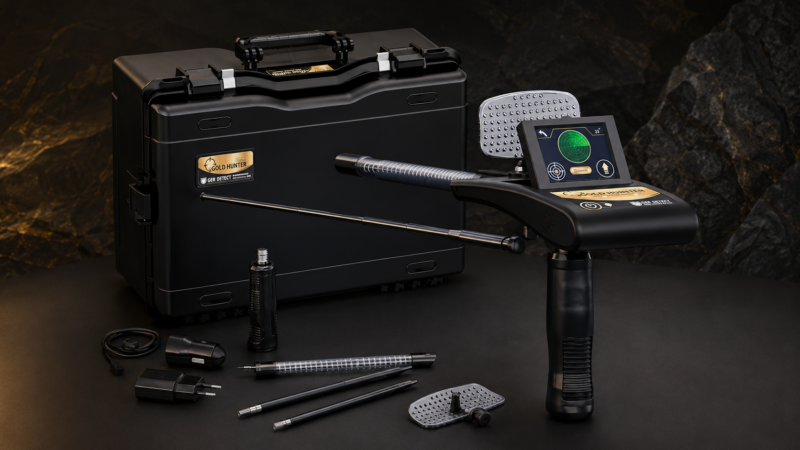
Gold Hunter Smart at a Glance
Before examining each search system in detail, the table below provides a quick overview of the Gold Hunter Smart’s main capabilities. These specifications show how the device combines wide-area long-range locating, selectable target detection, and two-dimensional depth analysis within one portable field system.
| Gold Hunter Smart | Specification |
GER Detect | Manufacturer |
| Germany | Country of Development |
| Long-range locating with 2D analysis | Detection Technology |
| 4 specialized systems | Number of Search Systems |
| 19 metal types | Selectable Metal Targets |
| Up to 50 m under suitable conditions | Maximum Depth |
| Selectable from 100 to 3,000 m | Forward Search Range |
| Metals, gold targets, diamonds, caves and voids | Main Targets |
| Touchscreen interface | Display |
| Arabic, English, German, French, Spanish and Italian | Supported Languages |
| Automatic adaptation for different terrain conditions | Ground Operation |
Gold Hunter Smart Parts and Components
Before using Gold Hunter Smart in the field, it is important to understand the main components that make up the detection system. Each part has a specific role in device handling, signal transmission, signal reception, and target analysis. The official user manual identifies the following primary components of the main unit.
Super Antenna:
The main extendable antenna used as part of the device’s long-range search configuration. The antenna can be extended when preparing the detector for wider forward search ranges.
Enhancer Antennas:
Additional antennas installed on the front section of the device as part of the search and signal system.
Recipient Antenna:
Installed beneath the forward section of the main unit and used as part of the device’s signal-reception configuration.
Dish Receiver and Signal Purifier:
The upper receiver dish is designed to receive and improve the search signal during operation.
Device Handle:
The detachable handle allows the operator to hold and balance Gold Hunter Smart correctly during directional searching and target confirmation.
Foldable Touchscreen:
The display provides access to device settings, target selection, search range, continent selection, depth measurement, and final result analysis.
Charge Input and Battery Indicator:
The charging port is located on the main unit, while the side indicator begins flashing when the battery level becomes low and the device requires charging.
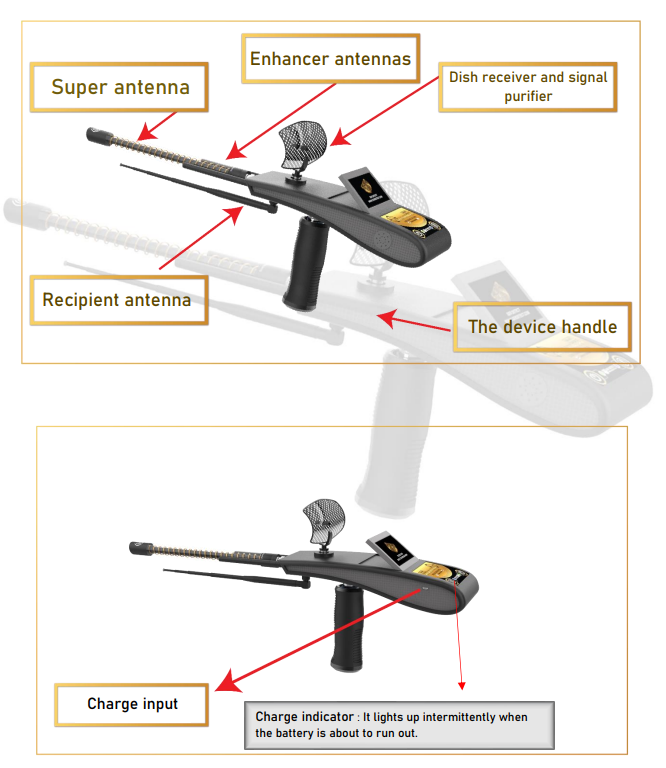
Gold Hunter Smart Technical Specifications
Gold Hunter Smart includes a full-color touchscreen interface, rechargeable internal battery, and a compact main unit designed for field use. According to the official user manual, the device uses a 320 × 240 pixel LCD touchscreen and operates across a stated frequency range of 3.2 to 16 kHz, with a data processing speed of 180 MHz.
| Specification | Details |
|---|---|
| Display | 320 × 240 px full-color LCD touchscreen |
| Frequency | 3.2–16 kHz |
| Data Processing Speed | 180 MHz |
| Operating Temperature | 0°C to 70°C |
| Operating Humidity | Up to 95% non-condensing |
| Storage Temperature | -20°C to 70°C |
| Battery Type | Internal rechargeable Li-ion battery |
| Battery Capacity | 18 Wh |
| Operating Time | Up to 10 hours |
| Water Protection | Not waterproof; weatherproof only |
| Device Weight | 325 g |
| Total Weight | 2720 g |
| Device Length | 220 mm |
| Length with Antenna | 425 mm (not extended) |
| Length with Extended Antenna | 695 mm |
| Audio Output | Dynamic speaker, 350–5500 Hz |
| Sound Output | 84 ± 3 dB |
What Comes with Gold Hunter Smart?
Gold Hunter Smart is supplied as a complete field package with the main detection unit and the accessories required for setup, charging, transport, and operation.
| Included Item | Description |
|---|---|
| Protective Carrying Case | Shock-resistant plastic case designed to protect the device and its accessories during transport and storage |
| Main Unit | The central Gold Hunter Smart control and detection unit |
| Device Handle | Detachable handle used to hold and balance the detector during operation |
| Main Charger | Standard charger for the internal rechargeable battery |
| Car Charger | Vehicle charger for field charging while traveling |
| Super Antenna | Main extendable antenna used in the long-range search configuration |
| Enhancer Antennas | Additional antennas installed on the main unit |
| Recipient Antenna | Receiver antenna used as part of the signal-reception system |
| Dish Receiver and Signal Purifier | Receiver dish used to receive and improve the search signal |
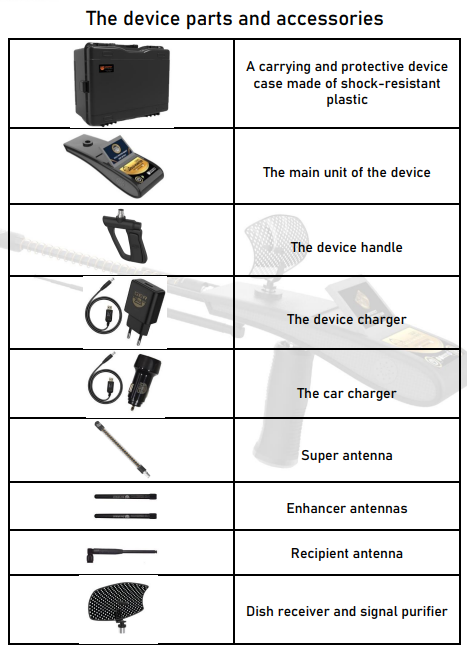
The Four Gold Hunter Smart Search Systems Explained
At the center of Gold Hunter Smart are four dedicated search systems, each designed for a different type of underground target or analysis task. Instead of forcing the operator to use one general mode for every search, the touchscreen interface allows the appropriate system to be selected before entering the field. The operator can move from wide-area target locating to target confirmation, depth estimation, and two-dimensional result analysis through a structured search process.
1. Gold and Metal Detection System
The Gold and Metal Detection System is the primary search mode for locating selected metallic targets across large open areas. Through the device interface, the operator can choose from 19 target categories, including natural gold targets, buried gold objects, meteorites, silver, copper, bronze, cobalt, coltan, mercury, zinc, lead, nickel, tin, lithium, and other metals. After selecting the required target and search region, the forward range can be adjusted through several distance levels between 100 and 3,000 meters. This configuration allows the search to be adapted to the size of the site instead of using maximum range for every field task. The system is intended to help the operator identify a potential target direction, repeat the scan from multiple positions, and gradually narrow the search area before moving to target confirmation and depth analysis.
2. Caves and Voids Detection System
The Caves and Voids Detection System shifts the search away from metallic targets and focuses on identifying potential underground empty spaces. This mode is intended for field investigations involving caves, tunnels, concealed chambers, ancient tombs, and other subsurface cavities that may differ from the surrounding ground structure. The operator begins by selecting the void-search mode, defining the search range, and scanning the area from more than one direction. When a consistent response is received, the suspected location can be approached gradually and checked again from several positions to narrow the search point. The manufacturer recommends confirming any indication through repeated scans rather than relying on a single pass. Soil composition, cavity dimensions, burial depth, terrain conditions, and correct device setup can all influence the field response, making systematic scanning and operator training essential for obtaining clearer results.
3. Diamond Detection System
The Diamond Detection System is a dedicated search mode intended to survey large areas for potential indications associated with underground diamond targets. From the touchscreen interface, the operator selects the diamond mode, defines the search region, and adjusts the forward range according to the dimensions of the site. The search should then be repeated from several directions to determine whether the response consistently leads toward the same location. Rather than treating the first signal as a final result, the operator gradually reduces the search distance and approaches the suspected point through a series of controlled scans. Once the location has been narrowed, the device’s depth and 2D analysis functions can be used as part of the confirmation process. Target size, burial conditions, surrounding minerals, soil composition, device configuration, and operator technique may all influence the response, so careful field verification remains essential.
4. 2D Imaging and Depth Determination System
The 2D Imaging and Depth Determination System represents the final analytical stage of the Gold Hunter Smart search process. After a potential target direction has been narrowed and confirmed through repeated scanning, this mode is used to examine the response and estimate the target’s underground depth in meters and centimeters. The touchscreen presents the result in a two-dimensional analytical format, helping the operator interpret the detected indication before making an excavation decision. For a more reliable assessment, measurements should be repeated from a stable position while keeping the device settings, target point, and scanning direction consistent. The displayed result should be understood as an analytical representation rather than a literal photograph of the underground object. Soil conditions, mineral interference, target dimensions, search noise, and operator technique can affect the reading, which makes careful confirmation and correct field training especially important.
Watch Gold Hunter Smart in Action
Seeing the device in operation makes it easier to understand its touchscreen interface, antenna configuration, search preparation, and field handling. The following video provides a practical visual introduction to Gold Hunter Smart and shows how its components work together during the search process.
How to Use Gold Hunter Smart: Step-by-Step Search Process
For complete assembly, safety, and operating instructions, consult the official Gold Hunter Smart user manual published by GER Detect. Operating Gold Hunter Smart follows a structured sequence that begins with correct assembly and device configuration, continues with target and range selection, and ends with directional confirmation and depth analysis. Each stage affects the quality of the final result, so the operator should avoid rushing directly into the search. Maintaining device balance, reducing nearby electronic interference, and repeating the scan from multiple directions are essential parts of the recommended field procedure.
Step 1: Assemble the Device and Prepare the Search Area
Before powering on the device, make sure the internal battery is fully charged and install the components securely in the correct order: the device handle, Super Antenna, enhancer antennas, recipient antenna, and dish receiver with signal purifier. Open the foldable touchscreen and extend the antenna according to the required forward search range. Gold Hunter Smart is weather-resistant but not waterproof, so it should not be operated in rain. The search area should also be kept away from electrical power sources, mobile network equipment, vehicles, large exposed metals, mobile phones, and active electronic devices that may increase signal noise. Once every component is firmly attached and the surrounding area has been checked for interference, the device is ready to be switched on.
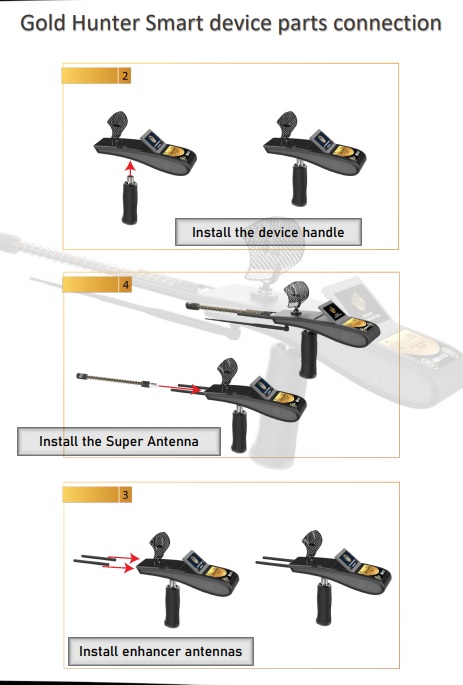
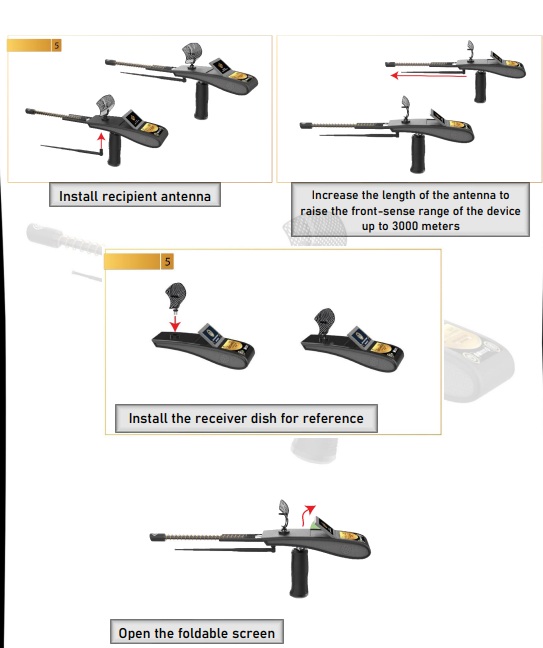
Step 2: Power On and Configure the Device
Press and hold the power button for approximately two seconds to switch on Gold Hunter Smart. Once the startup sequence is complete, the main screen displays the battery level, clock, temperature, and sound controls. Open the settings menu to select one of the six available interface languages: Arabic, English, German, French, Spanish, or Italian. From the same menu, adjust the sound level, screen brightness, time settings, and review the device information. Next, select the continent or region in which the search will be performed, as this setting forms part of the search configuration specified by the manufacturer. Before continuing, confirm that the battery indicator shows sufficient charge. If the side charge indicator begins flashing, stop the search and recharge the device using its original charger before returning to the field.
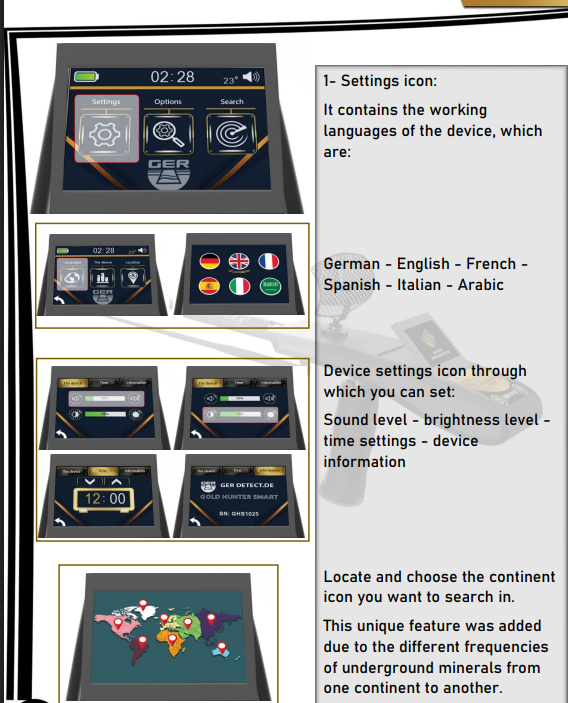
Step 3: Select the Target and Forward Search Range
Open the search options and select the specific target you want the device to locate. Depending on the chosen search system, the available options may include gold and other metals, diamonds, caves, or underground voids. After selecting the target, set the forward search range to one of the available levels: 100, 500, 1,000, 1,500, 2,000, 2,500, or 3,000 meters. The selected range should match the approximate size of the search area. For example, when the expected target location is contained within a 500-meter area, selecting 500 meters provides a more focused survey. The maximum 3,000-meter setting is more appropriate when the potential location is unknown or when an initial scan of a very large area is required. Using the smallest practical range can help the operator narrow the search more systematically during subsequent scans.
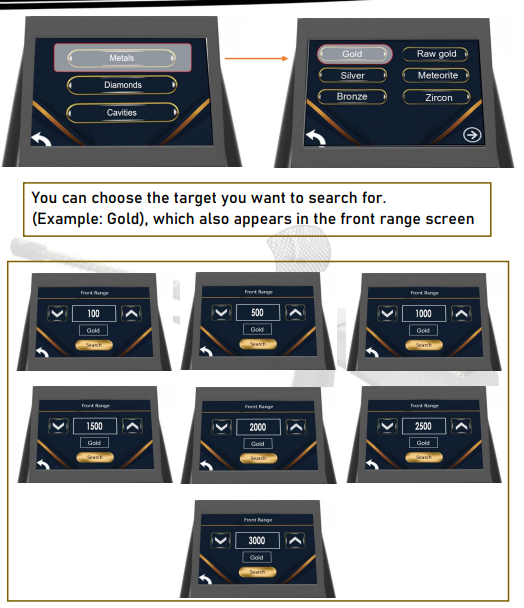
Step 4: Begin the Search and Maintain Device Balance
According to the manufacturer’s operating procedure, begin the search while standing on a north-to-south line and holding the device in a stable, relaxed position. Keep the balance indicator aligned by maintaining the yellow dot in the center of the on-screen circle, then press the search icon to activate the saved target, range, and continent settings. During the scan, the device produces a continuous sound while sending and receiving search signals. When a potential response is detected, the device may begin turning toward the indicated direction, the target-direction symbol appears on the screen, and the sound becomes faster. Do not force the handle toward a preferred direction or make sudden movements. Maintain balance, follow the indicated path slowly, and observe whether the same directional response appears again when the scan is repeated from a different starting position.
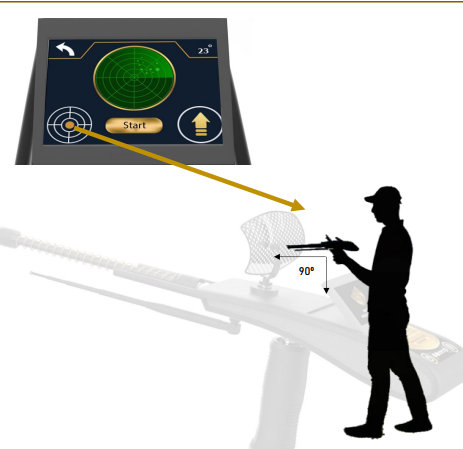
Step 5: Confirm the Target from Four Directions
Continue following the directional response until the device turns back, which indicates that the operator may have moved beyond the suspected target point. Mark the location, then repeat the search from all four directions: south to north, north to south, west to east, and east to west. Each scan should guide the operator toward the same central area. The intersection of these directional paths becomes the provisional target center and should be marked clearly before depth measurement begins. According to the operating procedure, the device should respond consistently when the operator approaches this point from each side and may rotate directly when positioned above the center. If the four scans do not converge on the same location, reduce the search range, check for nearby interference, rebalance the device, and repeat the confirmation process instead of accepting an uncertain signal.
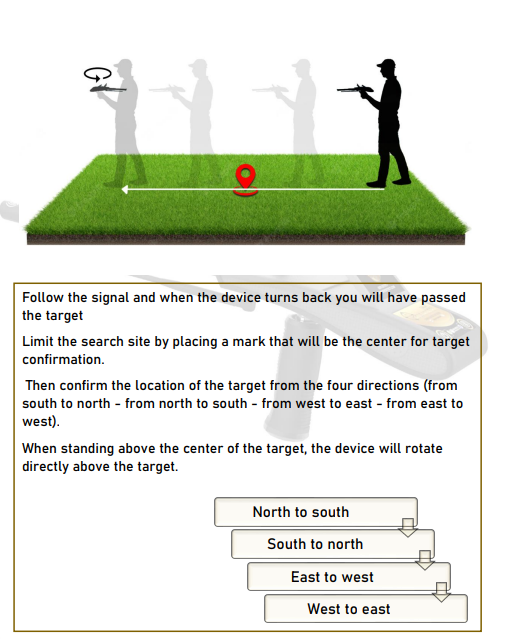
Step 6: Measure the Depth and Analyze the Final Result
After confirming the target center, select the depth function and move at least two meters away from the marked point. Face the suspected target while keeping the device balanced, press the start button, and wait for the confirmation beep. Walk slowly toward the target until the device turns backward and the rotation indicator appears on the screen. Next, turn to face the opposite direction, press the start button again, wait for the beep, and begin walking back toward the marked point. Continue until the device turns backward for a second time. Gold Hunter Smart then processes the two measurements and automatically displays the final analysis, including the search-area noise percentage, target-confirmation percentage, estimated depth range in meters and centimeters, and a two-dimensional figure representing the detected response.
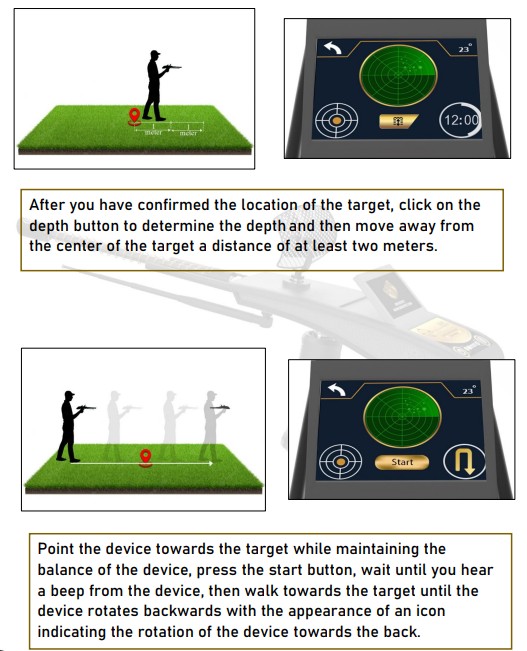
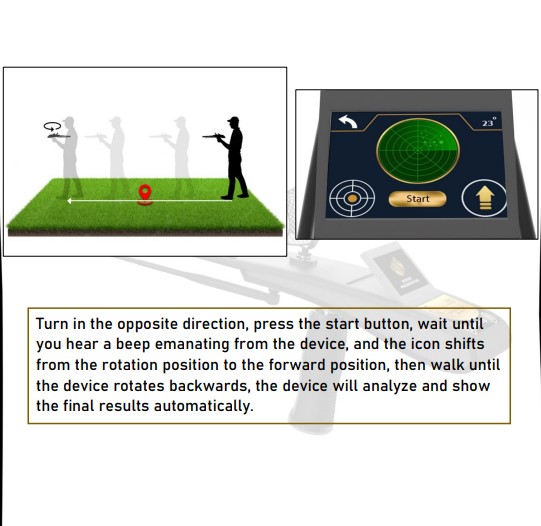
How to Read the Gold Hunter Smart Results
The final screen should be evaluated as a combined analysis rather than by relying on one number alone. Gold Hunter Smart displays four main result elements:
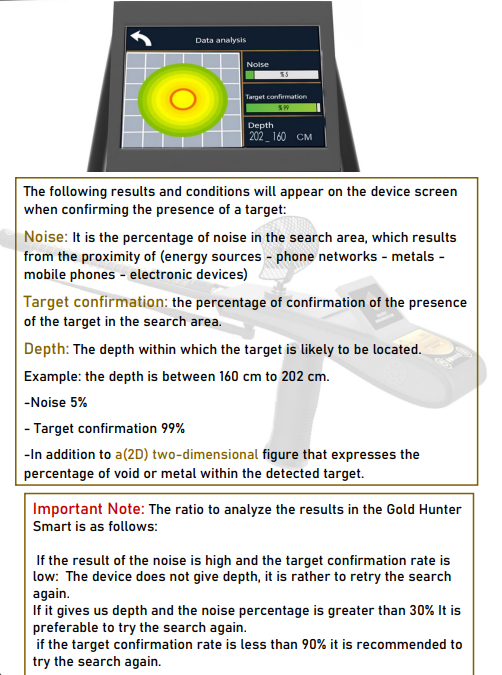
- Noise Percentage: This represents interference detected in the search area. Nearby electrical sources, mobile networks, phones, electronic equipment, vehicles, or exposed metals may increase the noise level. According to the manufacturer’s instructions, the search should be repeated when noise exceeds 30%.
- Target Confirmation: This indicates the device’s calculated level of confidence in the detected response. If target confirmation is below 90%, the manufacturer recommends checking for interference, repeating the four-direction scan, and generating a new measurement.
- Estimated Depth: The screen displays a probable depth range in meters and centimeters rather than presenting the result as one guaranteed exact point. This range should be compared with repeated measurements taken from the same confirmed location.
Understanding Gold Hunter Smart 2D Results
After the depth analysis is completed, Gold Hunter Smart displays a two-dimensional color result to help the operator interpret the detected response. According to the official user manual, the color pattern should be read together with the noise percentage, target-confirmation percentage, and estimated depth rather than used on its own.
Green and Yellow:
The manual indicates that a green-and-yellow result represents a target interpreted as being buried directly in the soil, rather than inside a void or metal container.
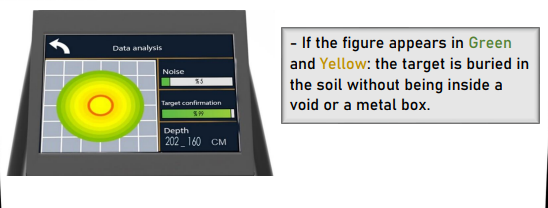
Red Gradient:
A red gradient indicates that the detected target may be located inside a metal box or metallic container.
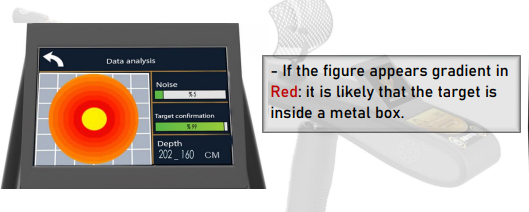
Blue Gradient:
A blue gradient indicates that the detected response may be associated with an underground void or empty space.
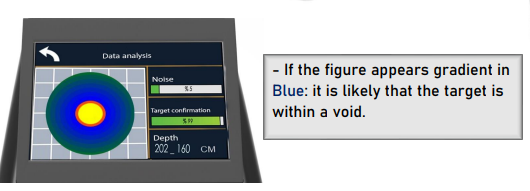
Gold Hunter Smart Search Tips for Better Results
For more consistent results, the Gold Hunter Smart user manual recommends following a controlled search procedure and reducing potential sources of interference before starting the scan.
Fully charge the battery before searching:
Make sure the device battery is fully charged before beginning field work. If the side battery indicator starts flashing, stop the search and recharge the device.
Avoid electronic interference:
Keep the search area away from nearby power sources, mobile networks, mobile phones, electronic equipment, and exposed metals that may increase the noise level.
Use only the original charger:
The manual specifically recommends using the original device charger.
Keep the device balanced:
During the search, maintain the yellow balance indicator in the center of the on-screen circle. Poor balance can affect directional confirmation.
Confirm the target from multiple directions:
Do not rely on a single directional response. The target location should be checked from north to south, south to north, east to west, and west to east.
Repeat the search when noise is high:
According to the manual, if the noise percentage is greater than 30%, it is preferable to repeat the search.
Repeat the search when target confirmation is low:
If the target-confirmation rate is below 90%, the manual recommends performing the search again before relying on the result.
Do not use the device in rain:
The manual warns against operating Gold Hunter Smart while it is raining. The technical specifications describe the detector as weatherproof, not waterproof.
Can Gold Hunter Smart Detect Newly Buried Targets?
According to the official user manual, freshly buried metals and targets placed directly on the ground may not produce the same response as targets that have remained underground for a long period.
The manual explains that the device’s long-range operating principle is based on what the manufacturer describes as ionic fields formed over time through the interaction of buried metals with the surrounding soil and the natural ground environment.
For this reason, GER Detect states that testing Gold Hunter Smart on newly buried objects or surface-laid metals may not demonstrate the detector’s intended long-range performance or maximum detection capability. According to the official user manual, these test conditions do not reproduce the underground environment in which the manufacturer says the device is designed to operate.
For more realistic testing, the manufacturer recommends evaluating the device under conditions that are closer to its intended field use rather than relying only on freshly buried test targets.
What Affects Gold Hunter Smart Detection Depth and Accuracy?
GER Detect specifies a maximum search depth of up to 50 meters and a selectable forward range of up to 3,000 meters for Gold Hunter Smart under suitable conditions. These figures represent maximum manufacturer-stated capabilities and should not be interpreted as guaranteed results for every target or location. Actual field performance can vary according to the target’s size, material, orientation, burial conditions, surrounding soil composition, mineral concentration, moisture, terrain, nearby electronic interference, selected search range, and the operator’s ability to maintain balance and confirm the response correctly. Larger targets and clearly defined underground structures generally produce different responses from small or irregular objects. The manufacturer also states that surface-laid metals and newly buried test targets may not represent the device’s intended long-range operating conditions. For this reason, repeated directional confirmation, controlled settings, realistic test conditions, and proper training are more important than relying only on the maximum depth or range printed in the specifications.
Gold Hunter Smart Review: What We Like
Gold Hunter Smart stands out for combining several search and analysis functions within one portable system. Instead of relying on a single operating mode, the device brings together long-range target selection, directional locating, depth estimation, and two-dimensional result analysis through one touchscreen interface.
Multiple search functions in one device:
The system is designed for several target categories, including metals, gold targets, diamonds, caves, and underground voids, giving the operator more flexibility when working in different field situations.
Adjustable forward search range:
The operator can select the forward range according to the size of the search area rather than using the maximum setting every time. Available settings range from 100 meters up to 3,000 meters.
Structured target-confirmation process:
Gold Hunter Smart does not rely only on the first directional response. The official procedure involves confirming the suspected target from four different directions before moving to depth analysis.
Useful result information:
The final analysis displays the noise percentage, target-confirmation percentage, estimated depth, and a 2D representation of the detected response.
Touchscreen and multilingual interface:
The device supports six interface languages and provides access to sound, brightness, time, device information, and regional search settings through the touchscreen.
Portable field package:
The main unit weighs 325 g, and the package includes a protective case, main charger, car charger, antennas, handle, and receiver components for field use.
Things to Consider Before Buying Gold Hunter Smart
Gold Hunter Smart is not designed to operate like a simple conventional metal detector. Its search process depends heavily on correct assembly, device balance, proper settings, directional confirmation, and careful interpretation of the final results.
Operator training matters:
The manual emphasizes correct setup and operating procedure, and incorrect use or high environmental noise can prevent the device from confirming a target or determining depth reliably.
Maximum range and depth are manufacturer specifications:
GER Detect states a maximum depth of up to 50 meters and a forward range of up to 3,000 meters, but these figures should not be interpreted as guaranteed performance for every target or search site.
Electronic interference can affect the search:
Nearby power sources, mobile networks, mobile phones, electronic devices, and exposed metals may increase the noise level and reduce result quality.
The detector is not waterproof:
The technical specifications describe Gold Hunter Smart as weatherproof only, and the manual specifically warns against using the device while it is raining.
Repeated confirmation is important:
A single response should not be treated as a final result. The device procedure relies on repeating the search from several directions and rechecking readings when noise is high or target confirmation is low.
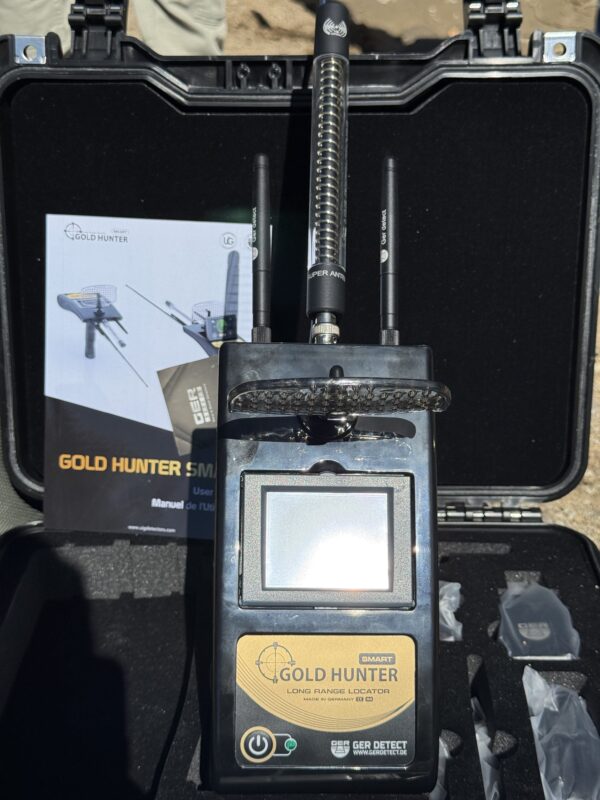
Frequently Asked Questions About Gold Hunter Smart
What is the maximum depth of Gold Hunter Smart?
According to GER Detect, Gold Hunter Smart can reach a maximum detection depth of up to 50 meters under suitable conditions. Actual performance may vary depending on target size, soil conditions, interference, burial conditions, and operator technique.
What is the maximum forward search range?
The forward search range can be adjusted from 100 meters up to 3,000 meters. Available settings include 100, 500, 1,000, 1,500, 2,000, 2,500, and 3,000 meters.
How many search systems does Gold Hunter Smart have?
Gold Hunter Smart is designed around four main search and analysis functions that cover metal and gold targets, caves and voids, diamonds, and 2D depth analysis.
What types of metals can Gold Hunter Smart search for?
The user manual lists several selectable targets, including raw gold, gold veins, silver, bronze, cobalt, coltan, mercury, copper, lithium, meteorites, and other metallic targets.
Can Gold Hunter Smart detect caves and underground voids?
Yes. The device includes a search mode intended for identifying underground voids and empty spaces. The final 2D analysis can also display a blue gradient that the manufacturer associates with a possible underground void.
Can Gold Hunter Smart detect diamonds?
According to the manufacturer, Gold Hunter Smart includes a dedicated search function for underground diamond targets. The user manual lists diamonds among the main target categories supported by the device.
What do the Gold Hunter Smart result colors mean?
According to the official user manual, green and yellow indicate a target interpreted as buried directly in the soil, red may indicate a target inside a metal container, and blue may indicate an underground void.
What does Target Confirmation mean?
Target Confirmation is the percentage shown on the result screen that represents the device’s calculated confirmation of a detected response. The manual recommends repeating the search if the confirmation level is below 90%.
Is Gold Hunter Smart waterproof?
No. The technical specifications describe the detector as weatherproof only, not waterproof. The manual also warns users not to operate the device while it is raining.
How long does the Gold Hunter Smart battery last?
According to the technical specifications, the internal 18 Wh rechargeable Li-ion battery provides up to 10 hours of operating time.
Gold Hunter Smart Review: Final Verdict
Gold Hunter Smart combines four specialized search systems, selectable long-range coverage, directional target locating, depth estimation, and 2D result analysis within one portable platform. Its greatest value is the ability to survey large areas and progressively narrow a potential location through a structured search process. However, it is not a simple switch-on-and-dig device; proper configuration, controlled scanning, repeated confirmation, and professional training are essential. For users who understand these requirements and need a multi-target long-range system for serious field exploration, Gold Hunter Smart offers a comprehensive set of tools backed by GER Detect technology and specialist support from Detectors Shop.
XP Metal Detectors, a French company, has built an outstanding global reputation in the field of gold, metal, and treasure detection. Known for its cutting-edge technologies, lightweight designs, and exceptional depth capabilities, XP continues to lead the industry with devices trusted by beginners and professional treasure hunters alike.
Proudly, Detectors Shop in Dubai is the exclusive and official distributor of XP devices in Dubai and the Middle East, offering 100% original products with a 5-year warranty and free professional training.
Let’s explore XP’s most popular and powerful detectors available now through Detectors Shop:
🔍 1. XP Xtrem Hunter
The XP Xtrem Hunter is a game-changer in deep metal detection. It’s designed specifically to locate large buried targets at impressive depths, making it the ultimate tool for professional treasure hunters.
Key Features:
- Detection depth: up to 5 meters
- Detection system: Advanced Pulse Induction (PI)
- Ideal for large-sized metallic targets and deep treasure caches
- Dual coil system with stable and accurate performance
- Robust build for tough environments
Perfect For: Deep treasure hunting and detecting buried metallic objects
⚙️ 2. XP Deus II
The Deus II is the world’s first wireless multi-frequency metal detector that is fully waterproof. Built with XP’s revolutionary FMF (Fast Multi Frequency) technology, it delivers unbeatable performance in all terrains and underwater.
Technical Highlights:
- Fully waterproof up to 20 meters
- Frequencies from 4 kHz to 45 kHz
- Wireless design with color display and headphones
- Lightning-fast signal processing
- High precision discrimination between metals
Perfect For: Detecting coins, relics, jewelry, and gold in any environment – land or sea
🎧 3. XP Deus II WS6 Master
The Deus II WS6 Master offers the full power of the Deus II in a lighter and more compact configuration. It replaces the main remote control with the WS6 module, offering full control and wireless operation.
Main Features:
- Full FMF multi-frequency capabilities
- WS6 control module with built-in screen and audio
- Ultra-light and portable
- Compatible with wireless XP headphones
Perfect For: Advanced users who want high-end performance in a minimalist setup
⚡ 4. XP ORX
The XP ORX is designed for serious gold prospectors and coin hunters who want powerful performance in a simple, user-friendly package. It excels in detecting fine gold nuggets in challenging terrains.
Top Features:
- Frequencies up to 81 kHz for maximum sensitivity
- Lightweight and ergonomic design
- Fast processing and intuitive menu
- Long-lasting rechargeable battery
Perfect For: Gold nugget detection, coin hunting, and small metal targets
Why Buy XP Devices from Detectors Shop – Dubai?
✅ Official and exclusive XP distributor in Dubai and the Middle East
✅ 100% genuine devices directly from XP France
✅ 5-Year international warranty
✅ Free training sessions by certified experts
✅ Fast delivery and excellent customer support
Get Your XP Device Today from Detectors Shop
Whether you’re a beginner or an experienced prospector, XP detectors offer the performance and reliability you need. And with Detectors Shop in Dubai, you’re guaranteed a trusted partner offering full after-sales support, training, and warranty coverage.
📞 Contact us now to order your device:
How to Use a Gold Detector Like a Professional?
The use of gold detectors has become increasingly popular among treasure hunters and hobbyists alike. With continuous technological advancements, it is now possible to find artifacts and buried gold with precision and ease. However, to achieve the best results and maximize the potential of the device, you need to follow some important steps and strategies. In this article, we will provide you with a detailed guide on how to use a gold detector like a professional.
1. Choosing the Right Device
The first step to success in gold hunting is choosing the right device for your needs. There are many types available in the market, but selecting a device that suits the type of soil and depth of the target is the key factor. For example, a device like Deep Seeker from Ger Detect offers advanced search systems that reach depths of up to 40 meters, making it ideal for searching for gold, metals, and buried treasures.
Deep Seeker

A complete professional device with 5 systems for detecting underground gold, precious metals, treasures, cavities, and caves
The Deep Seeker gold and buried treasure detector is specialized in detecting gold, buried treasures, ancient artifacts, voids, caves, and tombs underground.
The Deep Seeker can operate in all types of terrain and in the harshest weather conditions. It can also bypass all types of mineral rocks with automatic calibration technology.
The device contains 5 different search systems:
- Ionic field detection system.
- Magnetic metal detection system.
- Void detection system.
- 3D imaging system.
- Long-range sensor system.
The Deep Seeker can detect targets at depths of up to 40 meters underground with a front range of 3000 meters. The device weighs only 655 grams, and the total weight with accessories is 5600 grams. Its battery can operate continuously for up to 10 hours, and it can withstand various weather conditions.
The Deep Seeker is the first of its kind in the world to feature five innovative systems specialized in detecting underground treasures, precious metals, ancient artifacts, caves, and voids.
It is the best device for detecting gold and metals underground, operating with five search systems in one device, manufactured by Ger Detect in Germany, reaching depths of up to 40 meters underground and a front range of 3000 meters. The Deep Seeker is specialized in detecting gold, buried treasures, ancient artifacts, voids, caves, and tombs underground.
Systems
The Deep Seeker is a multi-system device for detecting gold, precious metals, buried treasures, and underground voids. It was designed to work in various terrains and in the harshest weather conditions.
The Deep Seeker can search through all types of mineral rocks with automatic calibration technology, including sedimentary, metamorphic, and igneous rocks, which consist of two types: granite and basalt. These are the worst types of rocks that hinder the operation of many devices available in the market due to their chemical reaction with the earth, transforming them into mineral-rich rocky textures.
Best Device for Detecting Gold and Metals Underground
Operating with five search systems in one device from Ger Detect, reaching depths of up to 40 meters underground and a front range of 3000 meters, the Deep Seeker is specialized in detecting gold, buried treasures, ancient artifacts, voids, caves, and tombs underground.
This multi-system device is designed for detecting gold, precious metals, buried treasures, and underground voids.
The Deep Seeker is the first device of its kind in the world to feature five innovative systems specialized in detecting underground treasures, precious metals, ancient artifacts, caves, and voids.
It is designed to work in various terrains and the harshest weather conditions. The Deep Seeker can search through all types of mineral rocks with automatic calibration technology, including sedimentary, metamorphic, and igneous rocks such as granite and basalt, which are the worst types of rocks that hinder the operation of many devices due to their chemical reaction with the earth, transforming into mineral-rich rocky textures.
2. Understanding Device Settings
Before starting your search, it’s essential to fully understand the settings of your device. Gold detectors vary in their technologies, and some feature multiple detection systems such as:
- Ionic system: for detecting gold buried in the soil for long periods.
- Ground radar system: for identifying underground formations, which helps locate large targets such as buried treasures.
- Electromagnetic system: used for searching for metallic objects at greater depths.
You should carefully read the user manual to understand all these systems and how to use them effectively.
3. Conduct Ground Balancing
Ground balancing is one of the most important steps to take before starting your search. By calibrating the device with the soil you are working on, you can reduce false signals and increase detection accuracy. Ground balancing adjusts the device according to soil composition changes, allowing you to detect real targets more clearly.
4. Choosing the Right Location for Search
Location is one of the most important factors that determine the success of your search. It’s best to search in areas historically known for gold deposits, such as mountainous valleys and desert regions where sand and soil accumulate over time. It’s also essential to be aware of local laws regarding gold prospecting, as some countries require special permits.
5. Using the Correct Search Technique
Using the right technique to move the detector over the ground is crucial. Keep the device at a steady, consistent height from the ground and make sure to cover the area thoroughly. It’s advisable to move in parallel lines to ensure no potential target is missed.
6. Accurately Handling Signals
When receiving a signal from the detector, don’t rush to dig immediately. Analyze the signal carefully using the different detection modes that your device offers. Many detectors come with a pinpoint mode that helps you accurately determine the location of the target before digging, reducing effort and saving time.
7. Using Essential Accessories
Modern gold detectors come with a set of accessories that help improve performance. Some of these accessories include:
- Headphones: for clearer detection of weak signals.
- Special digging shovel: to facilitate target extraction from the soil.
- Protective case: to shield the device from harsh weather conditions.
8. Patience and Persistence
Finally, success in using a gold detector depends greatly on patience and persistence. You may not find gold every time you search, but with continuous practice and patience, your chances of success will significantly increase.
Watch field experiments on YouTube and learn how to use a gold detector:
https://www.youtube.com/@detectors-shop
Using a gold detector like a professional requires experience and knowledge of the devices, along with practical skills in signal analysis and selecting the right locations. By applying the tips mentioned in this article, you can improve your chances of finding valuable treasures and gold pieces efficiently. Remember, continuous practice and using modern devices are the main keys to success.
If you’re looking for an advanced device that meets your needs, you can explore a range of the best gold detectors available at Detectors Shop, offering a 5-year warranty, free training, and excellent technical support.
The Secrets of Finding Buried Treasures Tips and Tricks for Achieving the Best Results
The practice of searching for buried treasures is one of the oldest hobbies that humans have engaged in throughout the ages. Ancient people sought to uncover wealth and treasures buried deep within the earth. With the advancement of technology, this process has become more accurate and effective, thanks to the use of advanced metal detection devices. In this article, we will explore some tips and tricks to achieve the best results in the quest for buried treasures.
1. Choosing the Right Device
The first step to achieving optimal results in treasure hunting is selecting the appropriate gold detector device. The device should be of high quality and suitable for the type of soil and area where the search will take place. For example, some devices are specialized in detecting gold, while others are designed for other types of metals. Additionally, there are devices that can differentiate between precious and non-precious metals.
Choosing the Right Gold and Metal Detector
Selecting the right gold and metal detector is a crucial step for success in treasure hunting and exploration. With a wide variety of devices available in the market, a researcher might feel confused when trying to choose the best device for their needs. In this article, we will outline the main factors that should be considered when selecting the right gold and metal detector to ensure the best results.
Determining the Targeted Metals
The first step in choosing the right device is to determine the type of metals you want to discover. Some devices are specifically designed for gold hunting, while others can detect a wide range of metals such as silver, copper, and iron. If your primary goal is to find gold, it’s better to choose a device specialized in gold detection, as its frequencies and design are compatible with gold’s properties.
Detection Depth
Metal detectors vary in their ability to reach different depths underground. If you are searching for deeply buried treasures, you will need a device capable of detecting at greater depths. However, if your goal is to find surface coins or artifacts, a device with medium detection depth might be the most suitable choice.
Type of Soil and Environment
The type of soil and surrounding environment play a significant role in choosing the right gold and metal detector. Some devices work more efficiently in sandy or clay soils, while others may be affected by soils with high mineral content. If you plan to search in mountainous areas or difficult soils, it is important to select a device that can operate effectively in these conditions without losing sensitivity or accuracy.
Metal Discrimination
The feature of metal discrimination is an important advantage in many modern detection devices. This feature allows the device to differentiate between precious metals like gold and silver and non-precious metals like iron. If you want to reduce the time and effort spent in excavation, choosing a device with a high discrimination capability will increase the efficiency of the search.
Weight and Size
User comfort is another important factor when choosing a gold and metal detector. The device should be lightweight and easy to carry, especially if you plan on conducting long searches in vast areas. Small, portable devices may be ideal in these cases, while larger devices might come equipped with additional features such as larger display screens and advanced functions.
Budget
The budget plays a major role in determining the appropriate device. The prices of metal detectors vary greatly depending on the brand, technical features, and capabilities. It is important to set a suitable budget and look for a device that offers the best value for money. Often, it may be better to invest in a mid-priced device that meets your needs rather than buying a cheap device that may not be effective.
Reading Reviews and Trying the Device
Before making the final decision, it’s helpful to read user and expert reviews on the device you are considering purchasing. These reviews provide an overview of the device’s performance in the field and give insight into its pros and cons. Additionally, if you have the opportunity to try the device before purchase, this would be a great advantage as you can check its ease of use and effectiveness.
Brand and After-Sales Service
The brand and quality of after-sales service are crucial factors when choosing a gold and metal detector. Reputable companies often offer longer warranties and excellent technical support, providing peace of mind for the user in case of any problems with the device. Choose a device from a well-known and proven brand to ensure you receive a high-quality product and reliable support.
Therefore, Detectors Shop offers a genuine 5-year warranty on gold and metal detection devices and provides free training on how to use the device correctly.
Choosing the right gold and metal detector requires an in-depth study of the various factors that affect the device’s performance and suitability for your specific needs. By determining the targeted metals, considering detection depth and soil type, paying attention to metal discrimination features, and setting a budget, you can find the ideal device that will help you achieve remarkable results in your treasure-hunting adventures. Remember, investing in a good device will increase your chances of finding buried treasures and achieving success in your hobby or profession.
2. Learning the Area’s History
To achieve the best results, the researcher must learn about the history of the area they intend to search in. Some areas might contain historical artifacts or stories related to buried treasures. Reading and researching the history of the place can help identify the best locations for searching and increase the chances of finding treasures.
3. Using the Correct Device Settings
Correct device settings play a significant role in improving the device’s performance and increasing the chances of finding treasures. The user must learn how to adjust settings such as sensitivity and metal discrimination according to the type of soil and weather conditions.
4. Searching in Neglected Areas
Sometimes, places that seem unpromising are the most likely to hold treasures. Neglected areas such as barren lands, dry valleys, and even deserted beaches might contain buried treasures that no one has discovered yet. Therefore, don’t hesitate to search in unconventional places.
5. Patience and Persistence
Patience is the key to success in treasure hunting. It might take a long time before finding anything of value, so it’s important for the researcher to be persistent and not give up easily. Every search operation is a learning experience, and over time, the researcher will gain new skills and increase their chances of success.
6. Paying Attention to Signs and Clues
During the search, you might come across signs and clues indicating the presence of buried treasures. These clues could be markings on rocks, changes in soil color, or even remnants of old materials. The researcher should stay alert and use these clues to pinpoint the exact location.
7. Preserving the Environment
It’s important for the researcher to preserve the environment during the search process. Avoid damaging nature or leaving waste behind. It is also recommended to restore the site to its natural state after the search is complete to maintain the aesthetic appearance of the area.
8. Working in a Team
Sometimes, working in a team can be more effective than working alone. Having others involved may help expand the search area and increase the chances of finding treasures. Additionally, team members can share experiences and information to achieve the best results.
9. Utilizing Modern Technology
In addition to metal detectors, modern technology such as geographic mapping programs and smartphone applications can be used to identify potential treasure sites. These tools can provide additional information and help plan the search operation more effectively.
10. Adhering to Local Laws
Finally, it is essential to adhere to local laws and regulations regarding treasure hunting. In some countries, you may need to obtain special permits before starting your search, and there may be laws prohibiting excavation in certain historical sites. Therefore, researchers should ensure they operate within the legal framework to avoid any legal issues.
Treasure hunting is a hobby that combines adventure, history, and technology. By following the tips and tricks mentioned above, researchers can increase their chances of finding buried treasures and achieving the best results. Most importantly, enjoy the process and remain patient and persistent, as every search journey carries the possibility of discovering something unique and exciting.

Devices for Detecting Artifacts and Treasures: The concept of treasure hunting and detecting buried treasures in the past was mainly about random digging underground or following symbols, signs, and clues indicating the presence of a nearby treasure. This process required time and effort, with a chance of either finding the treasure or coming up empty-handed. However, with continuous advancements, specialized devices have been developed for detecting gold, artifacts, and ancient treasures. These devices allow researchers to pinpoint their targets accurately and easily, enabling them to search properly using these advanced gold and metal detectors.
Importance of Devices for Detecting Artifacts and Treasures:
The significance of treasure hunting and detecting buried treasures varies from person to person, depending on each researcher’s goal. Some of the research objectives include:
- Understanding ancient civilizations through the artifacts and treasures buried underground.
- Learning about the habits, lifestyle, and activities of ancient people.
- Describing life in those time periods, allowing us to make the best use of available resources today.
- Studying and researching discovered treasures to gain valuable insights that can help uncover new and useful information in our current time.
- Enriching historical records written by historians with artifacts that enhance the accuracy of discovered information.
- Providing objective insights free from the bias of any historian.
- Pursuing a hobby for those who enjoy searching for ancient treasures and artifacts.
To successfully hunt for treasures, buried treasures, and voids, it is essential to follow modern and advanced methods using devices specifically designed for detecting artifacts and hunting buried treasures.
How to Detect Treasures and Buried Artifacts:
In the past, only archaeologists specialized in this field could discover the location of artifacts and hunt buried treasures through:
- Identifying the archaeological site.
- Surveying the archaeological site.
- Analyzing the survey results to pinpoint the expected location.
- Starting the excavation process using various methods.
- Documenting the discovered artifact.
Today, anyone interested in this field can excavate using advanced and effective devices to detect artifacts and hunt treasures.
The Evolution of Devices for Detecting Artifacts and Treasures:
Stages of Development of Devices for Detecting Artifacts and Treasures:
The Initial Stages of Discovering Devices for Detecting Artifacts and Treasures:
The journey of searching for buried artifacts, treasures, and precious metals began as a hobby and adventure with very primitive methods. However, as researchers became more interested in the physical laws of cosmic paths and the discovery of electromagnetic fields—which are the basis for any excavation device used today—ideas began to evolve to develop this effective tool for our goal.
The journey began with the discovery of electromagnetic induction by Michael Faraday in 1831, which marked a revolution in the world of electromagnetic excavation devices. The first effective detection device was built in 1965 using the BFO (Beat Frequency Oscillator) method. However, this method was still primitive and only useful for shallow areas with large targets.
The BFO phenomenon is defined as using the magnetic field generated by the currents in the search coils.
The Development of Devices for Detecting Artifacts and Metals in the 20th Century:
In the early 20th century, frequency drift became a significant obstacle to the effectiveness of treasure detection devices. Scientists began to research and study the problem, and it was resolved by Charles Garrett, who made design modifications to critical circuits and used high-specification components, thereby achieving stability in this field.
In 1982, the Deep Seeker device became widely used, fulfilling its purpose during that time despite its heavy weight and primitive, complex setup. Experts began conducting experiments to understand how each frequency corresponds with different metals. They discovered that low frequencies favored silver and brass, while high frequencies favored precious gold.
The Stage of Devices for Detecting Artifacts and Treasures in the 21st Century:
In this stage, there was a focus on pulse induction techniques that rely on electromagnetic fields. The design and handle of the devices were improved for user comfort, and clear crystal screens were incorporated, equipped with indicators to help the researcher understand the signals related to what is buried underground.
The market for effective and advanced devices for detecting artifacts and treasures has become very extensive, with devices tailored to the researcher’s specific goal. The best and most efficient device is chosen based on the researcher’s target, depending on the location and type of treasure they are searching for.
