







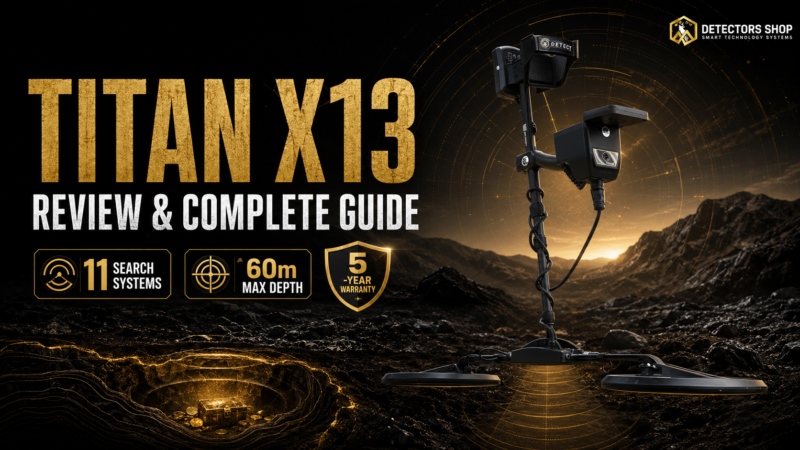
This Titan X13 review provides a detailed look at the 11-system professional detector developed by GER Detect for advanced underground exploration. Rather than depending on one search method, the device combines five detection technologies: long-range locating, pulse induction, electromagnetic field detection, magnetometer analysis, and ionic-field detection.
Together, these technologies are designed to help operators search for gold, precious metals, diamonds, gemstones, deeply buried metallic targets, caves, underground voids, and archaeological tombs. According to the manufacturer’s specifications, the Titan X13 can cover areas of up to 3,000 square meters, while its maximum advertised detection depth can reach 60 meters under suitable conditions. Actual results depend on the selected search system, target size and depth, soil conditions, interference, device settings, and operator experience.
In this complete guide, we will explain how all 11 Titan X13 search systems work, what each technology is designed to detect, the correct field workflow, technical specifications, realistic depth considerations, advantages and limitations, package contents, and the five-year warranty provided by Detectors Shop for GER Detect devices.
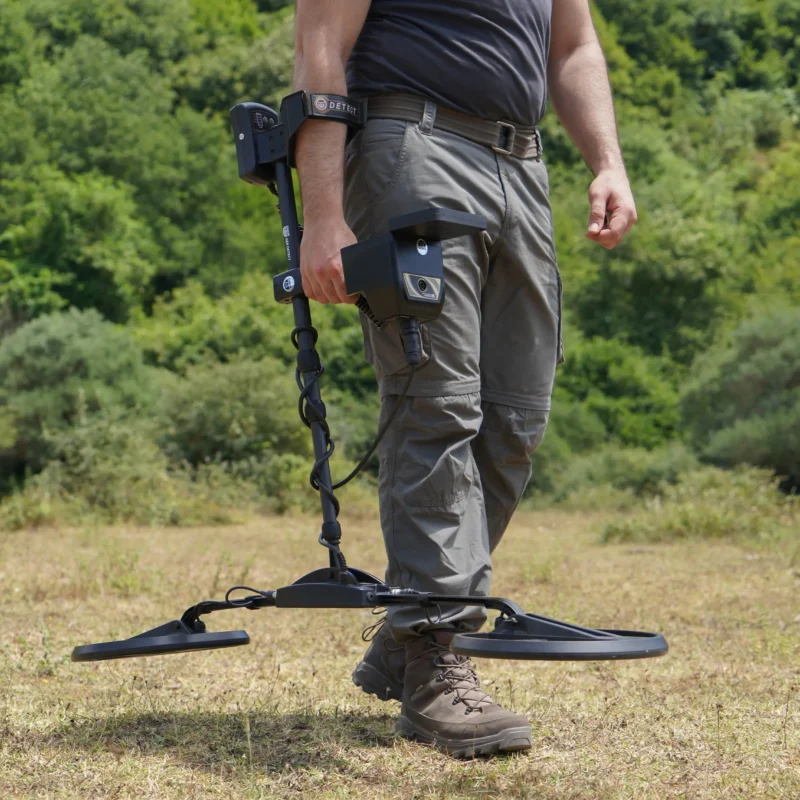
Table of Contents
What Is the Titan X13 Detector?
The Titan X13 is a professional multi-technology detector developed by GER Detect for investigating a wide variety of underground targets. It integrates 11 specialized search systems into one device, allowing the operator to select a detection method according to the target, terrain, and stage of the search. This makes it considerably different from conventional detectors that depend mainly on a single coil-based search technology.
Its five technology groups serve different purposes during field exploration. The long-range systems help survey wide areas and identify a potential direction, while pulse induction and EMF systems provide direct detection and target analysis. Magnetometer technology is used to investigate magnetic metals and underground voids, the 3D imaging function provides a visual representation of detected anomalies, and the ionic system is designed for long-buried targets. By combining these methods, the Titan X13 allows the operator to move from an initial survey to more focused analysis using one integrated field package.
| Specification | Details |
|---|---|
| Manufacturer | GER Detect |
| Number of Search Systems | 11 specialized systems |
| Detection Technologies | Long-range, pulse induction, EMF, magnetometer, and ionic detection |
| Maximum Advertised Depth | Up to 60 meters under suitable conditions |
| Maximum Coverage Area | Up to 3,000 square meters |
| Supported Targets | Gold, precious metals, diamonds, gemstones, buried metals, caves, voids, and archaeological tombs |
| Metal Selection | 12 selectable metal types |
| Gemstone Selection | 18 selectable gemstone types |
| Interface Languages | Arabic, English, German, French, Spanish, and Persian |
| Warranty | Five years through Detectors Shop for GER Detect devices |
The figures above represent the manufacturer’s maximum specifications. Detection depth and coverage can vary according to the selected system, target characteristics, soil conditions, environmental interference, and operator experience.
Additional technical information is available on the official GER Detect Titan X13 page.
Titan X13 Search Systems Explained
The Titan X13 combines 11 search systems divided across five detection technologies. Each group performs a different role: some systems are intended for surveying large areas, while others provide direct detection, underground analysis, or three-dimensional visualization. Selecting the correct system depends on the target being investigated and the conditions of the search area.
1. Long-Range Detection Systems
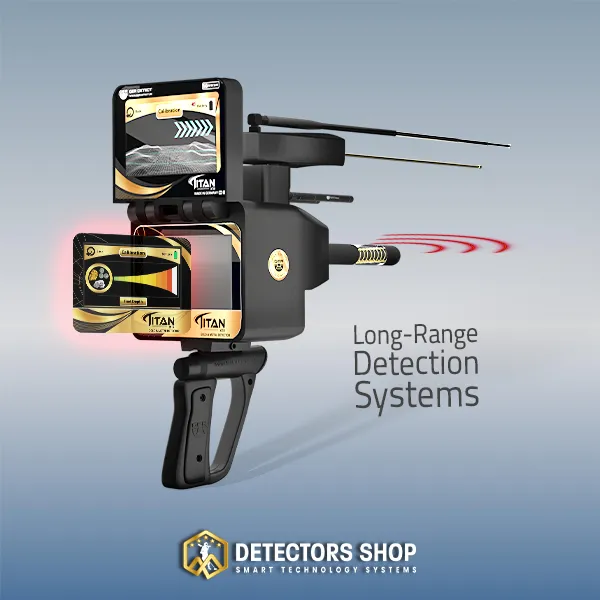
The long-range technology group includes four dedicated search systems designed for the initial exploration of large open areas:
- Gold and precious metals detection system
- Diamond detection system
- Gemstone detection system
- Custom long-range search system
According to the manufacturer, these systems can survey areas reaching 3,000 square meters and offer a maximum advertised depth of up to 60 meters under suitable conditions. The operator selects the required target category, surveys the area, and follows the detected direction to progressively narrow the possible target location.
For a more reliable field assessment, directional results should be checked from several positions and then investigated with one of the Titan X13 direct-detection or imaging systems. This structured process helps distinguish a repeatable target indication from environmental interference before any excavation decision is made.
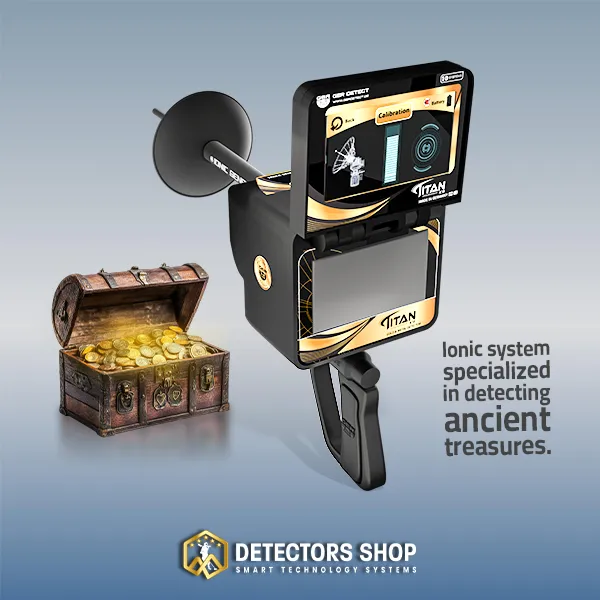
2. Ionic Detection System
The fifth Titan X13 search system uses ionic-field detection and is specifically intended for investigating ancient metallic targets that have remained underground for long periods. GER Detect describes this system as analyzing ionic-field anomalies that may develop around old buried objects, helping the operator identify areas that require closer examination.
Because the ionic mode is designed for long-buried targets, testing it with a newly buried object does not accurately represent its intended field use. The operator should scan slowly in an open area, observe whether the indication remains consistent, and repeat the search from another direction. Any potential signal should then be verified with a direct-detection, pulse induction, magnetometer, or imaging system before reaching a conclusion.
3. Magnetometer Detection Systems
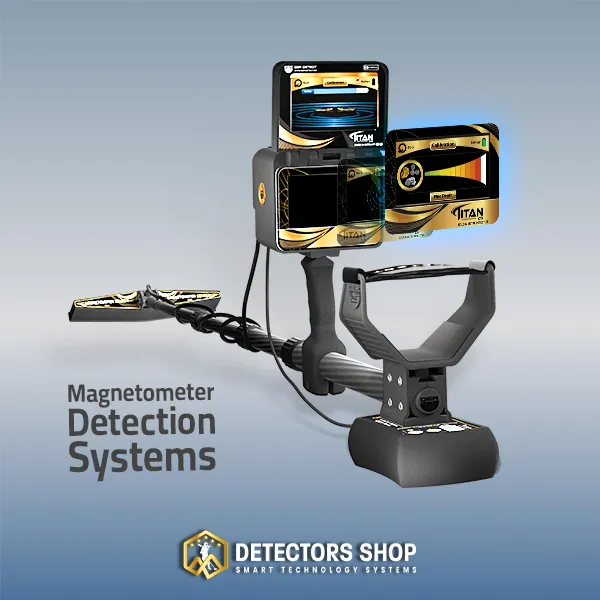
The Titan X13 includes two magnetometer-based search systems that measure variations in the Earth’s magnetic field:
- Void, cave, and archaeological tomb detection system
- Magnetic metal detection system
The first system is designed to locate underground anomalies that may indicate cavities, tunnels, caves, voids, or tomb-like spaces. The second is used to detect buried metallic objects that create a measurable magnetic disturbance, particularly ferrous or magnetic targets.
For an organized survey, the operator should scan the selected area in parallel lines while maintaining a consistent direction, speed, and sensor height. Repeating the scan from another direction helps determine whether an anomaly remains in the same location. Mobile phones, vehicles, power lines, reinforced structures, and nearby metal objects can interfere with magnetic readings, so the search area should be kept as clear as possible. Magnetometer results should be interpreted as underground anomalies and confirmed with another Titan X13 system before excavation.
4. Pulse Induction Detection Systems
The Titan X13 includes two pulse induction systems designed for the direct detection and analysis of buried metallic targets:
- General pulse induction search system
- Advanced pulse induction direct analysis system
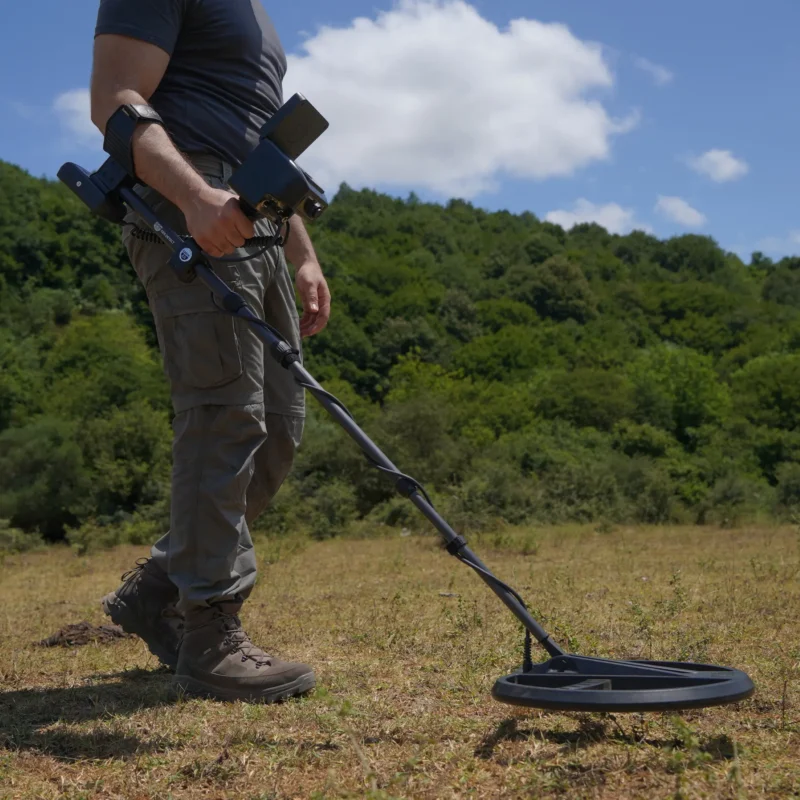
Pulse induction technology operates by transmitting electromagnetic pulses into the ground and analyzing the returning signal produced by a metallic object. The general search system is used to examine the selected area for potential metal responses, while the direct analysis system provides a more focused investigation after the possible target location has been narrowed.
During field use, the search sensor should be moved at a controlled speed and maintained at a consistent height above the ground. A genuine target response should remain concentrated in the same location when the area is scanned from different directions. Signal strength can be affected by target size, burial depth, soil mineralization, nearby metal, and device settings. For better confidence, pulse induction results should be compared with the EMF, magnetometer, or 3D imaging results.
5. EMF Direct Detection and 3D Imaging Systems
The final two Titan X13 systems use electromagnetic field technology for direct underground investigation and visual analysis:
- EMF direct detection system
- EMF-based 3D imaging system
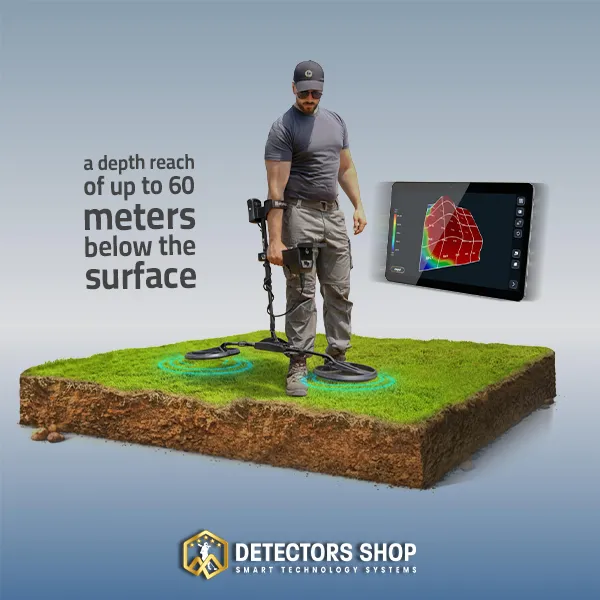
The direct detection system is designed to identify measurable electromagnetic anomalies associated with underground metallic targets or structural changes. After a potential location has been identified, the 3D imaging system allows the operator to scan the area systematically and convert the collected measurements into a visual representation for further analysis.
A three-dimensional scan should be understood as a visualization of recorded sensor data, not as a photographic image of an object beneath the ground. Its accuracy depends heavily on maintaining straight scan lines, consistent spacing, stable sensor height, and controlled movement throughout the survey. Repeating the scan in the opposite direction can help determine whether the anomaly remains stable. The imaging result should then be compared with indications from the pulse induction, magnetometer, or long-range systems before making an excavation decision.
How to Use the Titan X13: Recommended Field Workflow
A structured search process is essential when operating a multi-system detector. The exact procedure may vary according to the target and terrain, but the following workflow provides a practical method for combining the Titan X13 systems:
- Evaluate the search area: Inspect the terrain and identify power lines, vehicles, reinforced structures, surface metal, and other possible sources of interference.
- Select the intended target: Choose the appropriate system for gold, precious metals, diamonds, gemstones, magnetic metals, or underground voids.
- Perform the initial survey: Use the relevant long-range system to examine the wider area and identify a possible target direction.
- Repeat from multiple positions: Conduct the search from different sides of the area. A consistent intersection between repeated directions provides a stronger indication than a single response.
- Mark the potential location: Define a smaller search zone based on the repeated results instead of beginning excavation immediately.
- Apply a direct-detection system: Use pulse induction or EMF for metallic targets, or the magnetometer system when investigating magnetic metals, caves, voids, or tomb-like anomalies.
- Create a detailed scan: When appropriate, scan the narrowed area with the 3D imaging system using consistent lines, spacing, speed, and sensor height.
- Compare all results: A potential target becomes more convincing when two or more independent systems produce repeatable indications in the same location.
Operators should follow the official user manual, complete practical training, and obtain all required permissions before searching or excavating.
How Deep Can the Titan X13 Detect?
According to GER Detect, the maximum advertised detection depth of the Titan X13 can reach up to 60 meters under suitable conditions, with wide-area coverage of up to 3,000 square meters. This maximum figure is primarily associated with long-range surveying and large or deeply buried targets; it does not mean that every target or every search system can reach the same depth.
Actual detection depth depends on several factors:
- Size, shape, and type of the target
- Burial depth and length of time underground
- Soil composition and mineralization
- Moisture and surrounding terrain
- Selected Titan X13 search system
- Device settings and calibration
- Nearby electromagnetic interference
- Operator experience and search technique
A small metallic object will normally be detected at a shallower depth than a large underground structure or concentrated metal mass. For this reason, the 60-meter figure should be treated as a manufacturer-rated maximum rather than a guaranteed result. Reliable field evaluation depends on repeatable signals and confirmation through more than one detection system.
What Can the Titan X13 Detect?
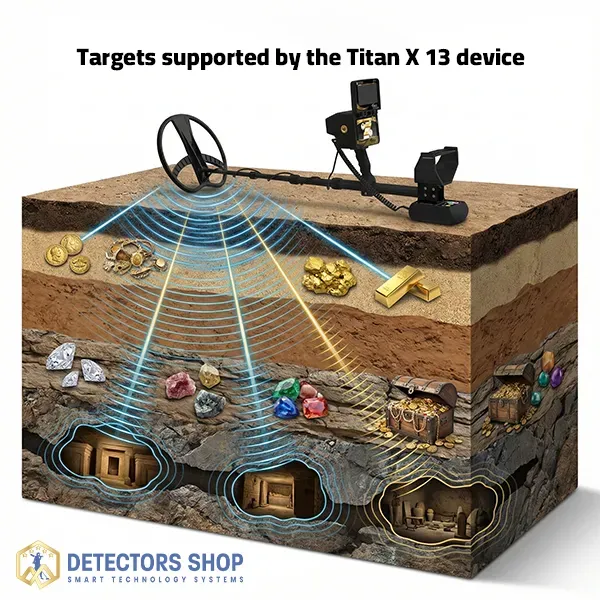
The Titan X13 is designed to investigate several categories of underground targets, including buried gold, raw gold, precious metals, diamonds, gemstones, metallic objects, caves, voids, tunnels, and archaeological tombs. The appropriate target program and detection technology should be selected before beginning the survey.
12 Selectable Metal Targets
The manufacturer lists search options for ancient buried gold, raw gold, platinum, silver, mercury, bronze, lead, copper, cobalt, lithium, coltan, and meteorite stones.
18 Selectable Gemstone Targets
The gemstone programs include ruby, emerald, quartz, topaz, agate, amethyst, lapis lazuli, tourmaline, columbite, tanzanite, turquoise, peridot, alexandrite, cat’s eye, sapphire, jasper, opal, and aquamarine.
Target selection helps configure the device for the intended search category, but it should not be interpreted as laboratory-grade material identification. A field indication must remain consistent when the scan is repeated and should be verified through another suitable Titan X13 system. The magnetometer and imaging functions can also be used to investigate underground anomalies associated with caves, voids, tunnels, and tomb-like structures.
Titan X13 Advantages and Limitations
A balanced Titan X13 review must consider both the flexibility of its multi-system design and the practical requirements of operating it correctly.
Main Advantages
- Eleven search systems combined in one professional package
- Five detection technologies for different targets and search stages
- Search programs for metals, diamonds, gemstones, caves, and voids
- Wide-area surveying followed by direct detection and 3D analysis
- Manufacturer-rated coverage of up to 3,000 square meters
- Maximum advertised depth of up to 60 meters under suitable conditions
- Interface support for six languages
- Ability to compare results from multiple independent systems
- Five-year Detectors Shop warranty for GER Detect devices
Important Limitations
- The number of systems creates a learning curve and requires proper training
- Maximum depth and coverage figures cannot be guaranteed in every location
- Environmental interference and incorrect settings can produce misleading signals
- Each system has a specific purpose and cannot detect every target equally
- Three-dimensional results require careful scanning and experienced interpretation
- The price is considerably higher than that of a simple single-purpose detector
The Titan X13 offers its greatest value when the operator understands how to select, combine, and verify its different systems. It is not intended as a simple recreational detector that can be operated effectively without preparation or field practice.
Who Should Buy the Titan X13?
The Titan X13 is best suited to professional exploration teams, experienced operators, and serious users who need several detection technologies in one device. It is particularly relevant for projects that begin with wide-area surveying and require additional systems for direct detection, void investigation, target analysis, and 3D visualization.
A serious beginner can also use the device after receiving proper training and learning the purpose of each system. However, the Titan X13 may not be the right choice for someone seeking an inexpensive recreational detector, simple coin hunting, or basic plug-and-play operation. Its value comes from combining multiple systems correctly and comparing their results during organized fieldwork.
Titan X13 Price, Warranty, and Support
At the time of publication, the Titan X13 price listed by Detectors Shop is US$13,000. Because prices, shipping arrangements, and available offers may change, buyers should check the official Titan X13 product page or contact the sales team for the latest information before ordering.
GER Detect devices purchased from Detectors Shop include a five-year warranty. Customers also receive professional device training, technical guidance, and after-sales support to help them understand the different search systems and operate the detector correctly. This support is particularly valuable for a device with 11 specialized systems and several field configurations.
Frequently Asked Questions About the Titan X13
How many search systems does the Titan X13 have?
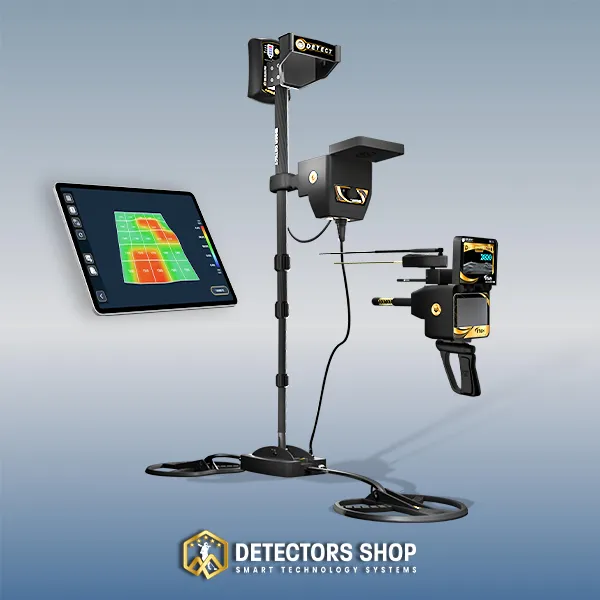
The Titan X13 combines 11 specialized search systems across five technologies: long-range detection, ionic detection, magnetometer analysis, pulse induction, and EMF detection with 3D imaging.
How deep can the Titan X13 detect?
According to GER Detect, the Titan X13 has a maximum advertised detection depth of up to 60 meters under suitable conditions. Actual depth depends on the target, soil, selected system, settings, and operator experience.
What targets can the Titan X13 detect?
The Titan X13 is designed to search for gold, precious metals, diamonds, gemstones, buried metallic objects, caves, underground voids, tunnels, and archaeological tombs.
Can the Titan X13 detect caves and underground voids?
Yes. The device includes magnetometer and EMF-based systems designed to investigate underground anomalies associated with caves, voids, tunnels, and tomb-like structures.
Is the Titan X13 suitable for beginners?
The Titan X13 can be used by serious beginners after proper training. Because it includes 11 search systems, operators must understand the purpose and correct settings of each technology.
Does the Titan X13 produce real 3D underground images?
The 3D system converts recorded sensor measurements into a visual representation of underground anomalies. It does not produce a photographic image of an object beneath the ground.
What is the Titan X13 price?
At the time of publication, the Titan X13 price is US$13,000. Check the official Detectors Shop product page for current pricing, availability, and shipping information.
What warranty is included with the Titan X13?
The Titan X13 includes a five-year warranty from Detectors Shop for GER Detect devices, together with professional training, technical guidance, and after-sales support.
Titan X13 Review: Final Verdict
This Titan X13 Review shows that the device’s greatest advantage is not simply its maximum depth specification, but its ability to combine several detection methods during one organized investigation. The operator can begin with wide-area surveying, narrow the potential location, apply direct detection, investigate metal or void anomalies, and analyze the selected area with 3D imaging.
The Titan X13 is best suited to professional teams and serious users who require multiple technologies and are prepared to complete proper training. Its results still depend on terrain, target characteristics, settings, interference, and operator experience, making repeated scans and confirmation through more than one system essential.
For current pricing, package details, availability, training, and the five-year warranty, view the official Titan X13 product page or contact the Detectors Shop team for a professional consultation before purchasing.
