











Choosing a raw gold detector starts with the target you want to find. Are you searching for small natural gold nuggets in the soil, or comparing equipment with several search systems for broader exploration? Target size, ground conditions, search method and operating experience all influence the choice.
This guide compares six models offered by Detectors Shop: Deus Gold, Gold Monster 1000, Gold Monster 2000, Titan X13, Titan 500 Smart and Gold Hunter Smart. It explains their different roles so you can choose equipment that suits your fieldwork.
For a broader overview, visit our gold detectors guide. You can also browse our raw gold detector category.
What Is Raw Gold, and What Can a Detector Find?
Raw gold is naturally occurring gold before refining or manufacturing. It may occur as nuggets, small pieces or gold within rock. A handheld metal detector searches for metal targets that produce a detectable response under the conditions at the site.
A gold-bearing rock does not always produce a detectable signal. The amount and distribution of gold, target size, depth and surrounding minerals affect the response. Finding a detectable piece is different from measuring the gold content of a rock or assessing a deposit.
Natural Gold Nuggets and Buried Gold
Nugget prospecting places particular importance on sensitivity to small targets and stability in mineralised soil. Buried jewellery or larger metal targets may require a different setup. A metal detector can respond to both natural and manufactured gold, but its suitability depends on the equipment and search conditions.
How Do Raw Gold Detection Technologies Differ?
Direct Searching with a Coil
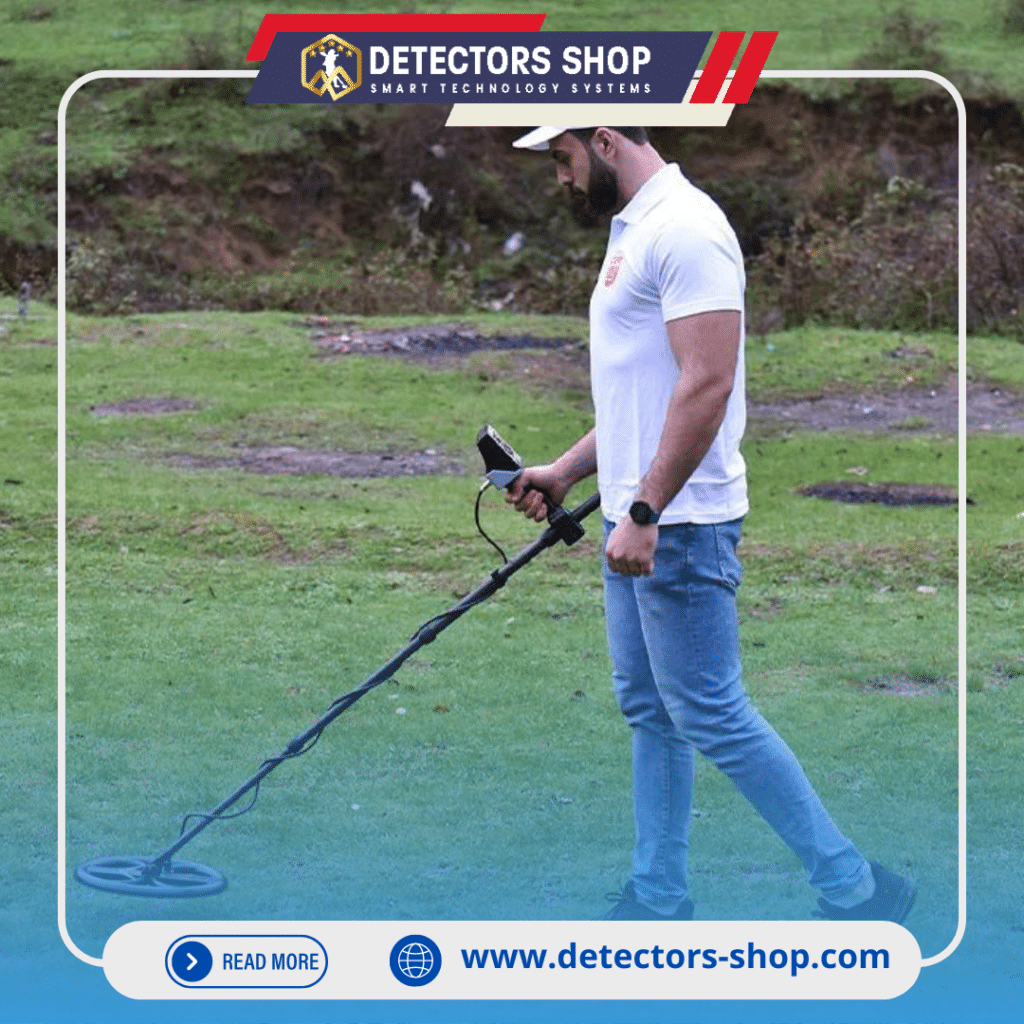
With a coil-based detector, the operator sweeps the ground and checks metal responses directly beneath the coil. This requires systematic coverage, stable settings and repeat checks of promising signals. Deus Gold and both Gold Monster models belong to this group.
VLF and Fast Multi-Frequency Technology
The Gold Monster 1000 uses 45 kHz VLF technology. Deus Gold combines the DEUS II platform with the HF2 coil, supporting FMF and mono-frequency operation. These approaches offer different ways to adapt to targets and soil; frequency alone does not determine performance.
Pulse Induction and Multi-Au
Titan X13 includes pulse induction among its advertised systems. Minelab describes the Gold Monster 2000’s Multi-Au as a hybrid technology combining VLF sensitivity with a pulse induction soil-handling engine. Understanding the actual system is more useful than grouping every detector under one label.
Long-Range Search Systems
Titan 500 Smart and Gold Hunter Smart are marketed by GER Detect as long-range systems. Their antenna-based operation differs from sweeping a coil over a nugget. Advertised range or depth figures do not establish the depth at which a small nugget can be detected, and manufacturer specifications are not independent field-test results.
Raw Gold Detectors at Detectors Shop
Start by comparing dedicated coil-based options for nuggets. Then consider the other systems if their functions match your wider search requirements.
1. Deus Gold with the White XP HF2 Coil
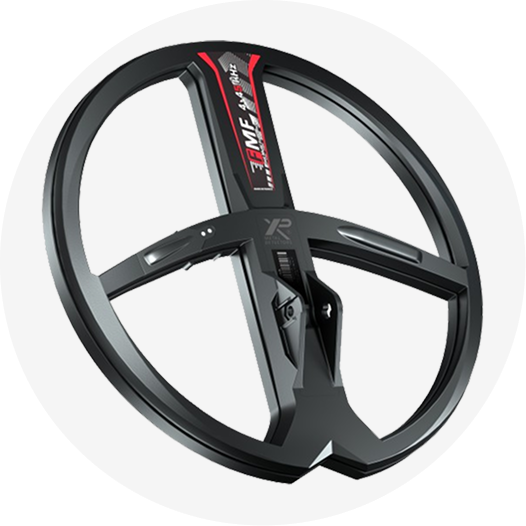
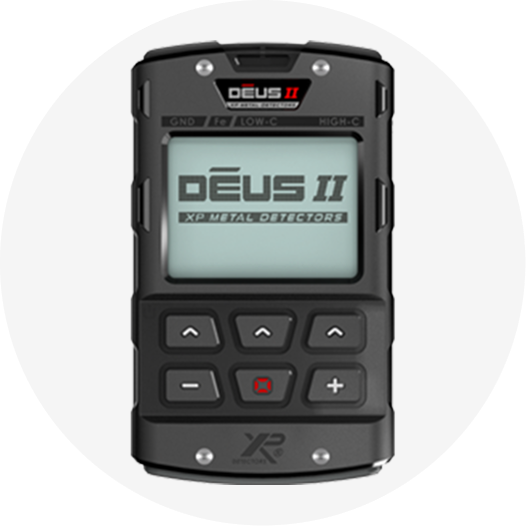
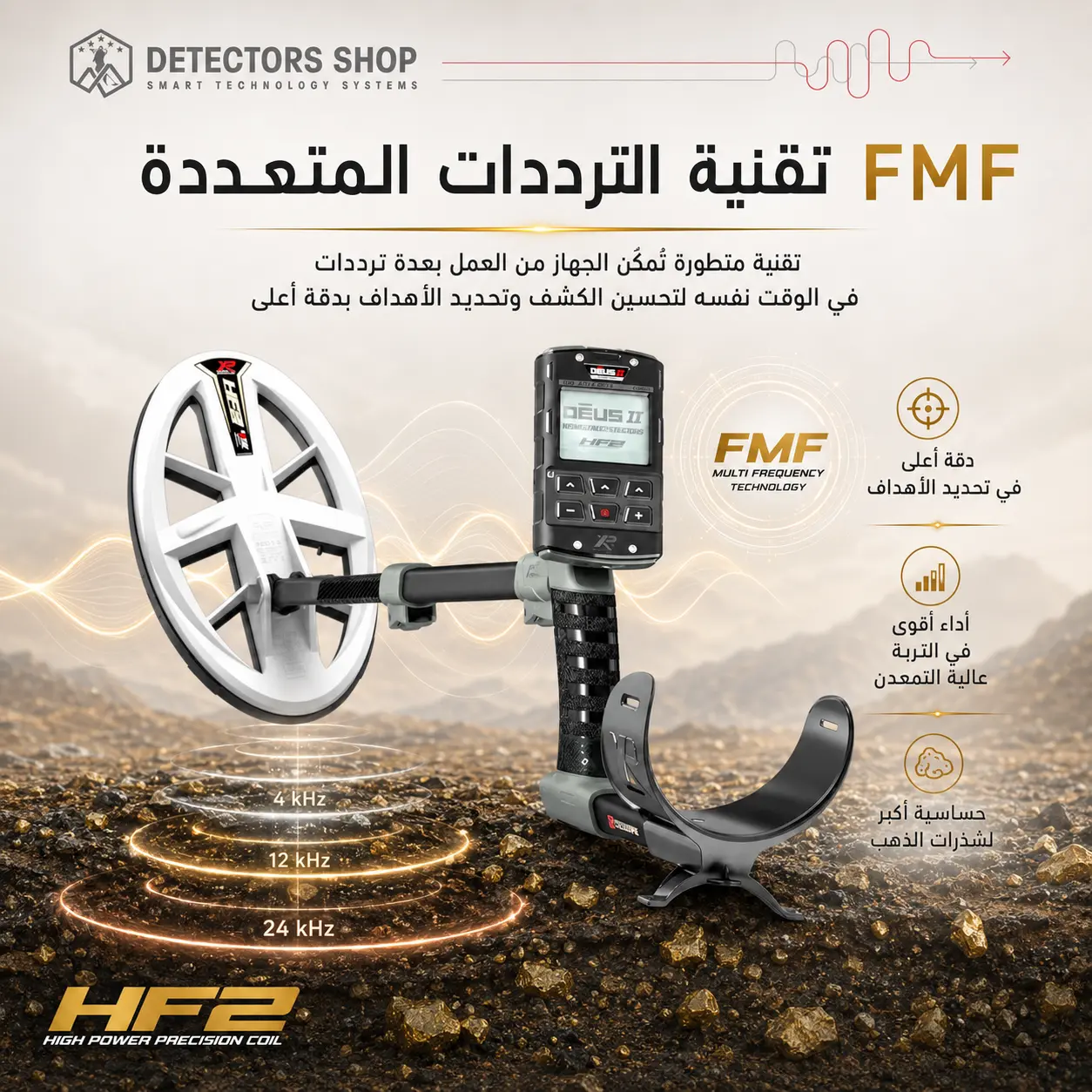
Deus Gold refers here to our XP DEUS II configuration with the white elliptical HF2 coil. XP specifies FMF operation from 9 to 90 kHz and mono-frequency operation from 9 to 120 kHz for this DEUS II-compatible coil.
Consider this setup if you want direct nugget searching with adjustable programs and frequencies. Its elliptical shape helps with coil placement around rocks and confined spaces. Learning ground balance and choosing stable sensitivity remain essential parts of using it.
- FMF and mono-frequency options.
- An elliptical coil for manoeuvring around obstacles.
- Adjustable settings for users willing to learn their setup.
Read our Deus Gold user guide and HF2 settings for operating guidance.
View Deus Gold product details, current price and package contents.
Product demonstration: This video is also included in our Arabic guide and may contain Arabic narration. Any shown result applies to the filmed test conditions.
2. Gold Monster 1000: Automatic Nugget Prospecting
The Gold Monster 1000 is a dedicated Minelab gold prospecting detector using 45 kHz VLF operation and 24-bit signal processing. Automatic ground balance and noise cancellation reduce setup steps, while sensitivity can be automatic or manual.
It is an option for prospectors who want a relatively simple interface for direct coil searching. Its Gold Chance Indicator helps assess a response, but cannot confirm that an unrecovered target is gold.
- Gold-focused VLF operation.
- Automatic functions with manual sensitivity adjustment.
- Audio responses for checking targets during a sweep.
Minelab lists the coil as waterproof to one metre and the detector as splash/rain proof. A waterproof coil does not make the control unit suitable for submersion.

View Gold Monster 1000 product details, current price and package contents.
3. Gold Monster 2000: Multi-Au for Mineralised Ground
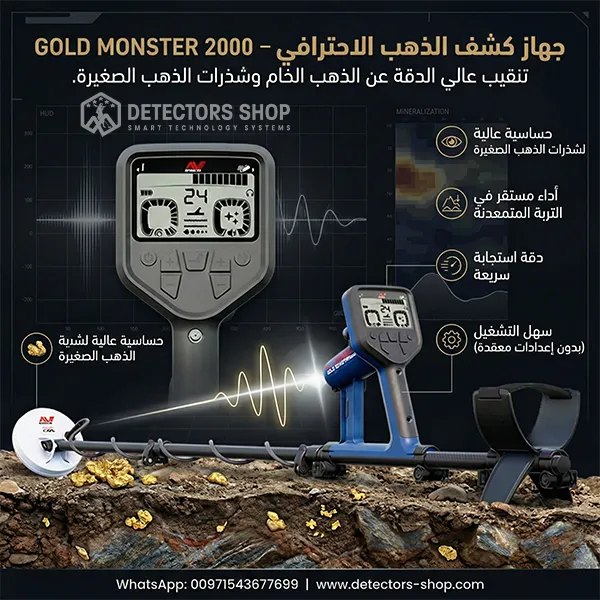
The Gold Monster 2000 uses Minelab’s Multi-Au hybrid technology for fine-gold prospecting in mineralised ground. The manufacturer describes it as combining VLF sensitivity with a pulse induction soil-handling engine.
Features include Echo Wave Audio, a Gold Chance Indicator, target identification and automatic ground tracking with Quick-Trak. These help the operator assess signals and ground conditions, while target recovery remains necessary to identify a find.
Consider it when comparing dedicated nugget detectors for challenging ground. Read our Gold Monster 2000 review and settings guide for more detail.
View Gold Monster 2000 product details, current price and package contents.
4. Titan X13: Multiple Search Systems
GER Detect presents Titan X13 as an 11-system detector with functions including pulse induction, EMF and 3D imaging. The important purchasing question is which system and accessories you will use for your particular target.
Its pulse induction function provides a basis for considering direct metal searching, but sensitivity to fine nuggets should be assessed using the intended coil and settings. A depth figure advertised for the complete system should not be treated as the detection depth of a small piece of gold.
Consider Titan X13 if you need equipment for several tasks. Ask for a demonstration of the specific search system you expect to use, with targets comparable to yours.
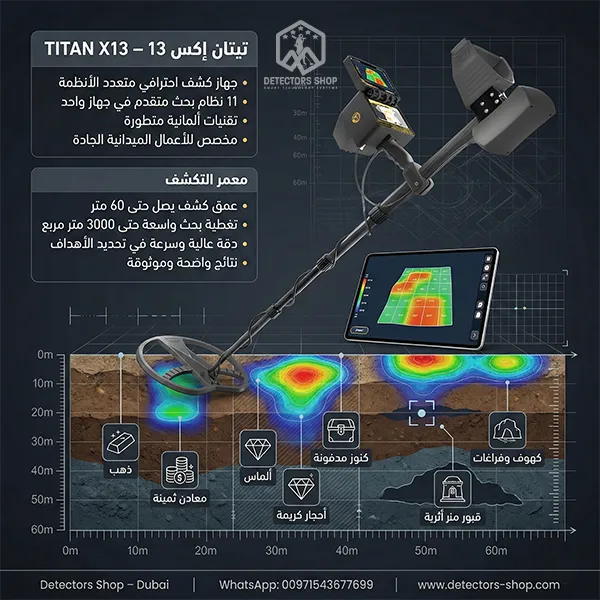
View Titan X13 product details, current price and package contents.
5. Titan 500 Smart: Long-Range Search Functions
Titan 500 Smart is marketed by GER Detect for long-range searching for gold, metals, diamonds and gemstones. The manufacturer includes raw gold among its stated targets and provides search settings for different tasks.
Its operation differs from direct coil-based nugget searching. Evaluate the system according to the function you intend to use and request a relevant practical demonstration before selecting it for small natural gold targets.
Our Titan 500 Smart review and field guide explains the equipment and operating approach.
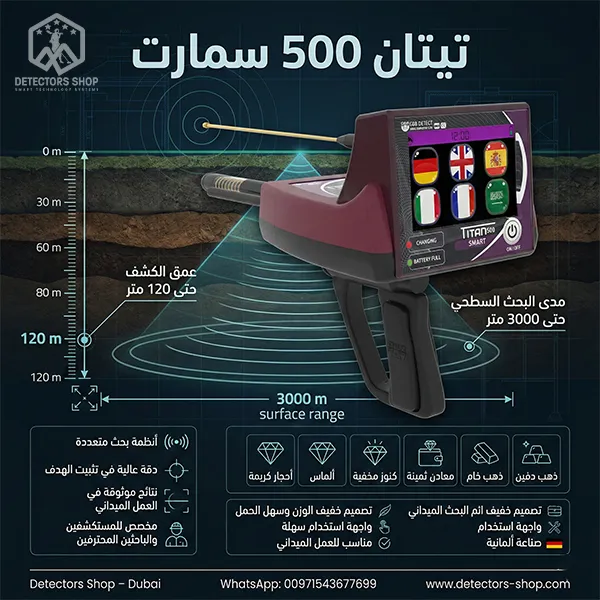
View Titan 500 Smart product details, current price and package contents.
Product demonstration: This video is also included in our Arabic guide and may contain Arabic narration. Any shown result applies to the filmed test conditions.
6. Gold Hunter Smart: Long-Range Search and Analysis
GER Detect describes Gold Hunter Smart as a long-range device with four search systems, including metal, diamond and void searching, plus a 2D analysis function. Raw gold is among the manufacturer’s stated targets.
Consider it when comparing equipment with several target-selection and analysis functions. Its antenna-based searching differs from detecting a nugget beneath a search coil, and a 2D display should not be interpreted as a photograph of underground gold.
If small nuggets are your main objective, assess that use through a suitable demonstration before purchase. Confirm the supplied accessories and learn how results should be interpreted.
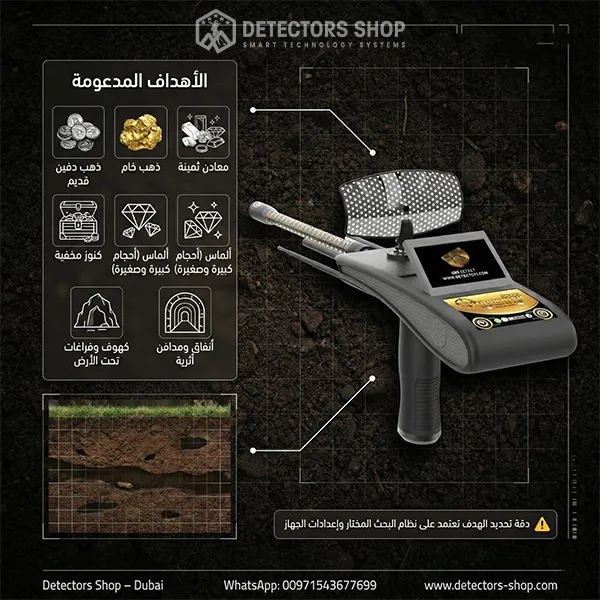
View Gold Hunter Smart product details, current price and package contents.
Raw Gold Detector Comparison Table
This table compares technologies and use cases. It is not a ranking based on identical field tests. Define your target size and ground conditions before selecting a detector, coil or search system.
| Detector | Technology / method | When to consider it | What to verify |
|---|---|---|---|
| Deus Gold + HF2 | Direct coil; FMF and mono-frequency | Small targets with adjustable settings | Ground settings, program and coil configuration |
| Gold Monster 1000 | Direct coil; 45 kHz VLF | Gold prospecting with automatic setup functions | Package contents and stable sensitivity in your soil |
| Gold Monster 2000 | Direct coil; Multi-Au hybrid | Fine-gold prospecting in mineralised ground | Ground response and hot-rock handling |
| Titan X13 | 11-system platform, including PI | Several search tasks involving different systems | The selected system and sensitivity to your target |
| Titan 500 Smart | Long-range searching | Comparing long-range exploration functions | A relevant field demonstration and operating method |
| Gold Hunter Smart | Long-range device with four systems | Multiple target types and analysis functions | Result interpretation and suitability for your task |
Which Detector Should You Choose?
- For direct nugget searching: start with Deus Gold, Gold Monster 1000 and Gold Monster 2000.
- For adjustable programs and frequencies: study Deus Gold with HF2 and learn its ground settings.
- For fewer setup steps: compare the automatic functions of the Gold Monster models.
- For several search tasks: assess Titan X13 system by system.
- For long-range functions: understand Titan 500 Smart and Gold Hunter Smart, then request a demonstration relevant to your target.
A higher price or more systems does not automatically mean greater sensitivity to small nuggets. Choose according to your main task.
How to Use a Coil-Based Raw Gold Detector
These steps apply to direct coil searching. For antenna-based or multi-system equipment, follow the manual for the selected system.
- Prepare the equipment: charge the battery, secure the coil and adjust the shaft for comfortable sweeping.
- Select the program: use the gold search mode recommended in your model’s manual.
- Manage ground and interference: perform ground balance and noise cancellation as instructed.
- Choose stable sensitivity: reduce excessive noise instead of always using the maximum setting.
- Overlap your sweeps: keep the coil close and parallel to the surface, using an appropriate sweep speed.
- Recheck responses: confirm repeatability and locate the signal from more than one direction.
- Recover and inspect: check the recovered target, then rescan the hole and removed soil.
What Affects Gold Nugget Detection Depth?
There is no single depth for every nugget or location. Target size, shape, orientation and depth interact with mineralisation, interference, coil design, settings and sweep technique.
Ask for a test using targets and soil comparable to your search conditions, with the coil and settings clearly identified. An air test helps you learn a response, but does not reproduce buried-target performance.
Common Prospecting Mistakes
- Choosing equipment using advertised depth alone.
- Increasing sensitivity until ground noise obscures useful signals.
- Lifting the coil at the end of a sweep or leaving gaps between passes.
- Ignoring a repeatable weak signal.
- Treating a gold indicator or target number as confirmed metal identification.
- Keeping the same settings after ground conditions change.
Raw Gold Detector Prices and Buying Advice
Cost depends on the model, coil, accessories and supplied package. Use the product links above to check current prices, and read our metal detector price guide for Dubai and the UAE for additional buying context.
Contact Detectors Shop to discuss target size, soil, budget and operating guidance. Confirm package contents, warranty terms, available training and delivery arrangements for your order.
Raw Gold Detector FAQs
What is the best raw gold detector for small nuggets?
The choice depends on nugget size, soil and experience. Compare Deus Gold with HF2, Gold Monster 1000 and Gold Monster 2000 for direct coil searching, and assess them under conditions similar to your site.
Is Deus Gold different from DEUS II?
Deus Gold in this guide means the DEUS II configuration supplied with the white XP HF2 coil. It describes the prospecting setup, rather than a separate detector platform.
How do Gold Monster 1000 and 2000 differ?
The 1000 uses 45 kHz VLF technology. The 2000 uses Multi-Au hybrid technology and adds features including Echo Wave Audio and target identification. Both search directly with a coil.
Do all six detectors operate the same way?
No. Deus Gold and the Gold Monster models are coil-based detectors. Titan X13 combines several systems, while Titan 500 Smart and Gold Hunter Smart use long-range search methods.
Can a detector identify only gold?
Discrimination and target indicators help assess signals, but different metals can produce similar responses. Recovering and inspecting the target is necessary to establish what it is.
Does a higher frequency always mean more depth?
No. Frequency interacts with target size, ground conditions and detector design. Coil choice, ground balance, sensitivity and sweep technique also influence the response.
Need help choosing a gold prospecting detector?
Tell us your expected target size, soil conditions, country of use and budget so we can help you compare suitable equipment.
Technical References
The technology descriptions refer to manufacturer information. GER Detect system descriptions reflect the manufacturer’s claims rather than independent performance tests.
