








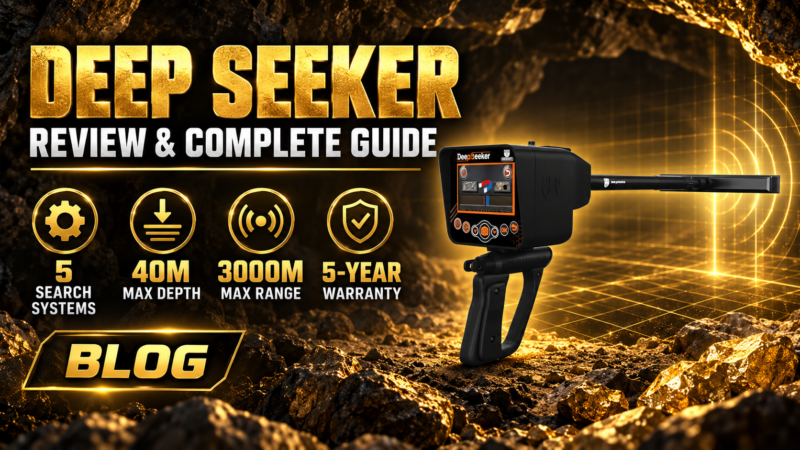
Deep Seeker Review provides a detailed and practical look at a professional multi-system detector developed by GER Detect and UIG Detectors for investigating buried gold, precious metals, ancient artifacts, caves, and underground voids. Instead of relying on a single detection method, Deep Seeker combines five dedicated technologies: 3D ground imaging, long-range locating, ionic-field detection, magnetometer scanning, and void detection.
According to the manufacturer’s specifications, the general maximum detection depth reaches up to 40 meters, with a forward range of up to 3,000 meters. The ionic system is separately advertised with a maximum depth of up to 45 meters and a forward range of 2,500 meters. These figures represent manufacturer-rated maximums rather than guaranteed results, since actual performance depends on target size, burial conditions, soil composition, mineralization, environmental interference, device settings, and operator experience.
This complete guide explains what each search system does, how to operate the device through a structured field workflow, its advantages and limitations, technical specifications, package contents, price, and the five-year warranty provided by Detectors Shop.
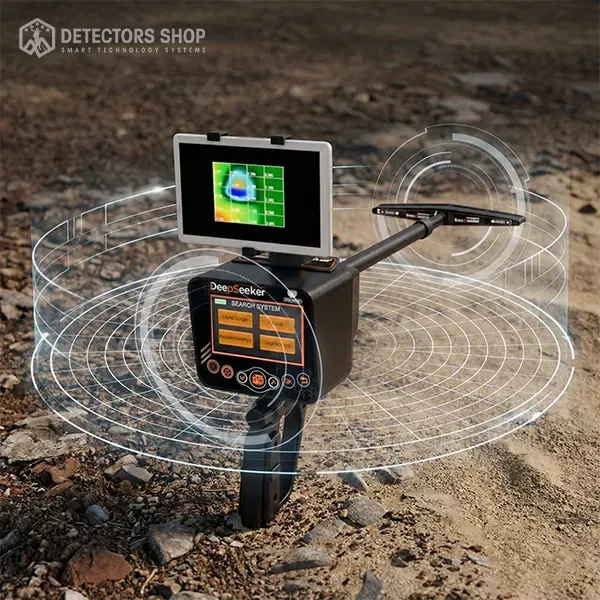
Table of Contents
What Is the Deep Seeker Detector?
Deep Seeker is a professional multi-technology exploration device developed by GER Detect in Germany. It integrates five specialized search systems into one platform for investigating buried gold, precious metals, ancient artifacts, caves, tunnels, and underground voids.
Unlike conventional detectors that depend mainly on one search technology, Deep Seeker supports a structured, multi-stage investigation. Its long-range and ionic systems help survey broader areas and identify potential directions, while the magnetometer and void-detection functions investigate magnetic objects and underground cavities. The 3D imaging system records ground-scan measurements and converts them into a visual representation for analyzing the approximate location, shape, size, and depth of an underground anomaly.
Deep Seeker should therefore be considered a professional survey and analysis tool rather than a simple recreational detector. Obtaining reliable results requires selecting the correct search system, adjusting the device for the terrain, following an organized scanning method, and confirming every indication through repeated scans or another suitable system.
Deep Seeker Specifications at a Glance
The following table summarizes the most important Deep Seeker specifications. Detection depth and range figures are manufacturer-rated maximums; actual performance varies according to the target, soil, interference, settings, and operator experience.
| Specification | Details |
|---|---|
| Manufacturer | GER Detect |
| Country of Origin | Germany |
| Search Systems | 5 specialized systems |
| General Maximum Depth | Up to 40 meters |
| Ionic System Depth | Up to 45 meters |
| General Forward Range | Up to 3,000 meters |
| Ionic System Range | Up to 2,500 meters |
| Main Targets | Gold, precious metals, ancient artifacts, magnetic metals, caves and voids |
| Display | Full-color LCD touchscreen, 480 × 270 pixels |
| Operating Time | Up to 10 hours |
| Operating Temperature | 0°C to 70°C |
| Total Package Weight | Approximately 5.6 kg |
| Water Resistance | Weather-resistant, but not waterproof |
| Supported Languages | Six interface languages |
| Warranty | Five years from Detectors Shop |
The Five Deep Seeker Search Systems Explained
Deep Seeker combines five specialized search systems, with each technology serving a different stage of the investigation. The operator can begin by surveying a wide area, identify a possible direction, examine magnetic or empty-space anomalies, and then perform a detailed ground scan before considering excavation.
“This review was prepared based on the official Deep Seeker specifications and our experience supplying the device to customers.”
1. 3D Imaging System
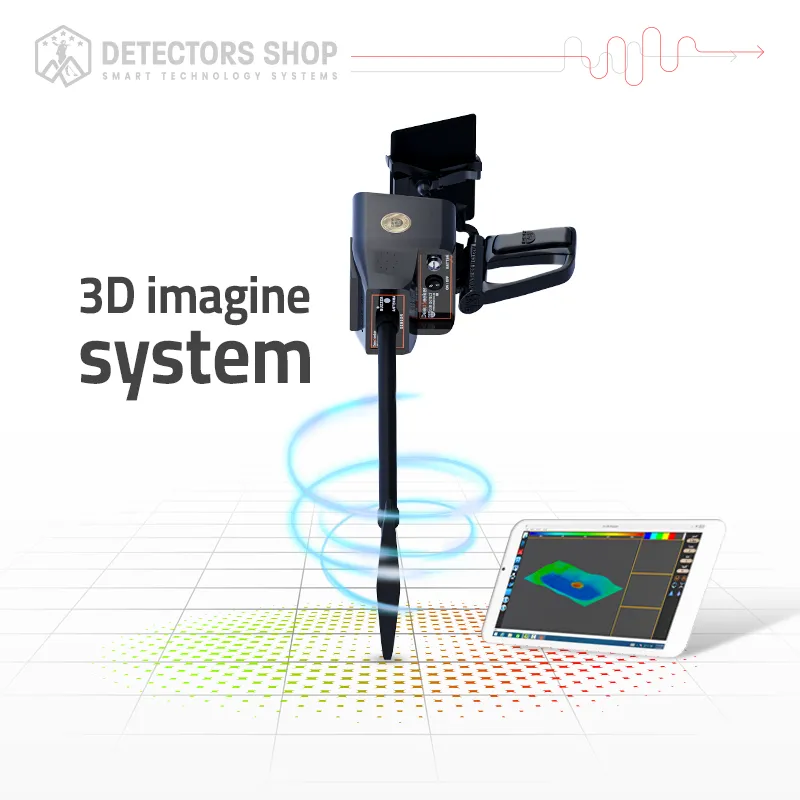
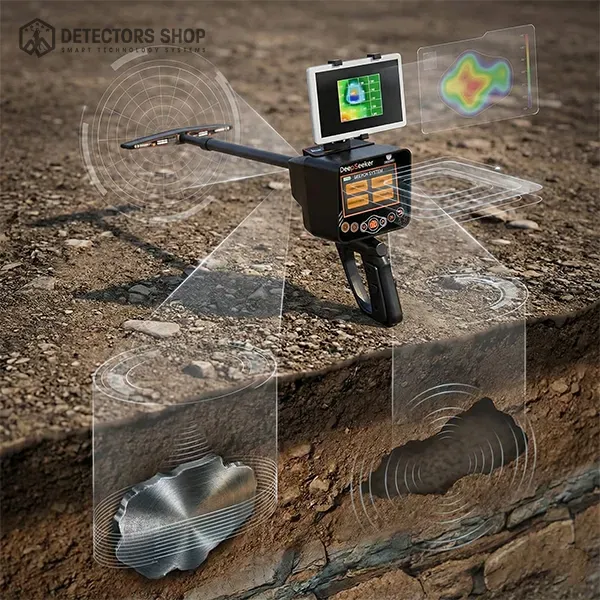
The 3D Imaging System is designed to record measurements from the ground and convert them into a visual representation of underground anomalies. It can be used to investigate buried metallic targets, caves, voids, tunnels, and changes within the soil structure.
For accurate scanning, the operator should divide the selected area into organized parallel lines, maintain a consistent walking speed and sensor height, and avoid nearby sources of electromagnetic interference. The completed scan can help estimate the approximate position, shape, size, and depth of the detected anomaly.
The displayed result is an interpretation of recorded sensor measurements—not a photographic image of an object underground. Any important indication should therefore be scanned again from another direction and confirmed with another suitable Deep Seeker system before excavation.
2. Long-Range Detection System
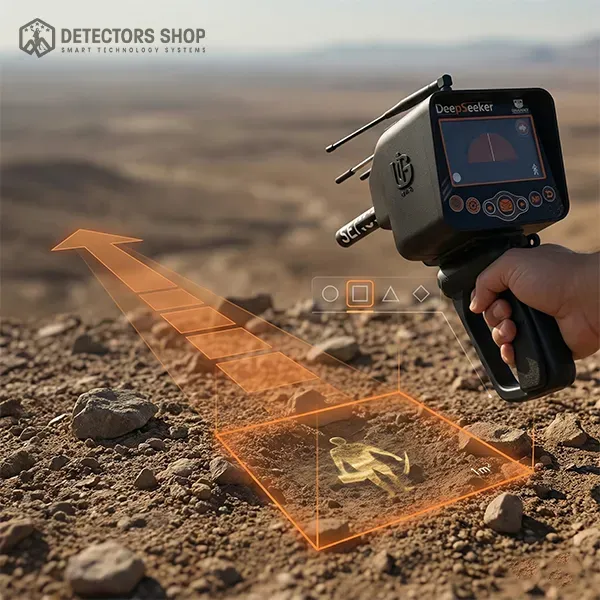
The Long-Range Detection System is intended for the preliminary survey of large open areas. It allows the operator to select a target category—such as buried gold, raw gold, silver, bronze, diamonds, or underground voids—and search in the chosen direction before beginning a detailed ground scan.
According to the manufacturer, the system offers a maximum forward range of up to 3,000 meters. When a potential indication is detected, the receiver turns toward the suspected target direction, the direction appears on the display, and an audible signal helps guide the operator. By repeating the search from several positions, the potential area can be progressively narrowed.
Long-range indications should always be checked from at least four directions. Nearby vehicles, electrical lines, communication equipment, metallic structures, and incorrect ground settings may affect the result. For this reason, the Long-Range Detection System should be used to identify a possible search zone, while final confirmation should be performed with the 3D imaging, magnetometer, or void-detection system.
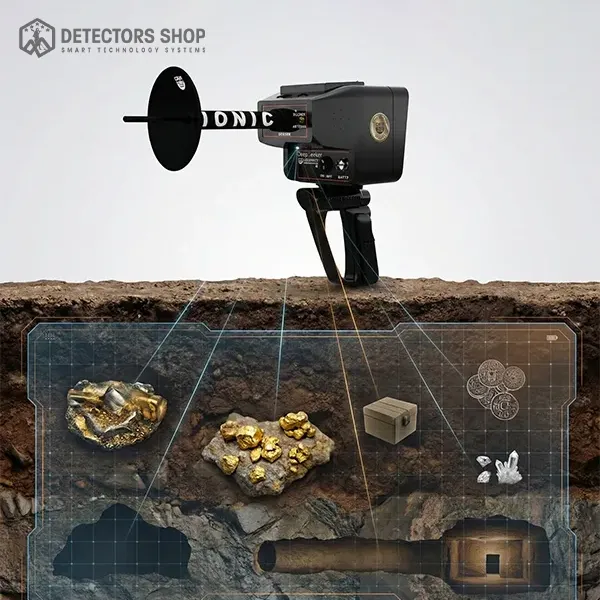
3. Ionic Field Detection System
The Ionic Field Detection System is designed primarily for investigating metallic targets that have remained underground for long periods. The manufacturer describes the system as responding to ionic-field changes associated with old buried gold, precious metals, and ancient treasures.
According to the published specifications, this system has a maximum advertised depth of up to 45 meters and a forward range of up to 2,500 meters. It can be operated while walking through the search area and may also be used during a controlled vehicle survey.
When an indication is detected, the device provides an audible alert to help the operator identify the suspected area. Because soil mineralization, electrical interference, and environmental conditions can influence field readings, every ionic indication should be repeated from different directions and confirmed with another Deep Seeker system before excavation.
4. Magnetic Metal Detection System (Magnetometer)
The Magnetometer System measures variations in the Earth’s magnetic field to investigate ferrous and magnetically responsive objects beneath the surface. It is particularly useful for locating iron, steel, and other magnetic materials that may be associated with buried structures, containers, or archaeological sites.
The manufacturer advertises a maximum detection depth of up to 40 meters under suitable conditions. However, the magnetometer does not directly identify non-magnetic precious metals such as pure gold. Instead, it detects magnetic anomalies that require further investigation.
For reliable results, the operator should scan the area in organized parallel lines while maintaining consistent sensor height and walking speed. Mobile phones, vehicles, power lines, reinforced concrete, and metal objects carried by the operator can interfere with readings. Any anomaly should be rescanned from another direction and compared with the 3D imaging or another appropriate system.
5. Void Detection System
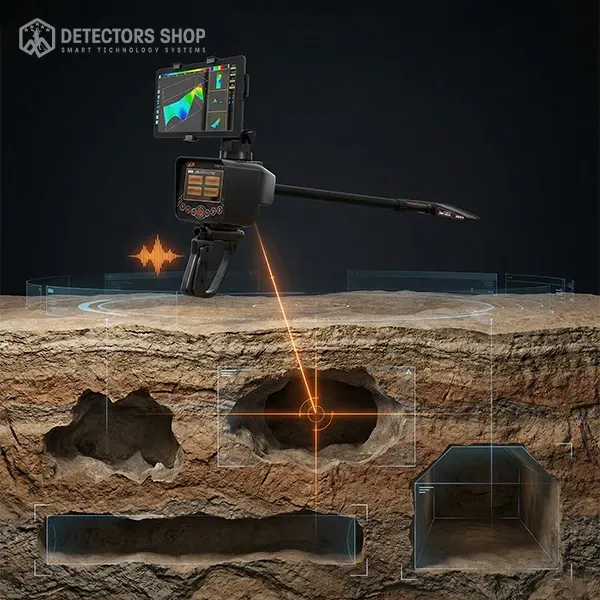
The Void Detection System is designed to identify subsurface anomalies that may be associated with caves, tunnels, chambers, tombs, and other underground spaces. It helps the operator investigate areas where the ground response differs from the surrounding soil.
For better reliability, scan the suspected location from more than one direction and mark any repeatable indication. The result should then be examined with the 3D Imaging System to better understand the anomaly’s approximate shape and position.
A void indication does not automatically confirm a man-made chamber or determine whether excavation is safe. Natural soil variations, geological formations, utilities, and nearby interference can produce similar responses. Actual detection depth depends on the void’s size, soil conditions, settings, and operator experience.
How to Use the Deep Seeker: Recommended Field Workflow
Deep Seeker delivers its best results when its five systems are used as complementary investigation tools rather than as separate shortcuts. The following workflow helps reduce false signals and improves target verification.
1. Prepare the Search Area
Inspect the site and remove nearby sources of interference whenever possible, including vehicles, mobile phones, electrical cables, fences, and large surface metals. Select the appropriate operating settings and allow the device to adapt to the ground conditions.
2. Conduct a Long-Range Survey
Use the Long-Range Detection System to examine large areas and identify a possible target direction. Approach the indicated location from several directions instead of relying on a single response.
3. Confirm the Indication
Mark the point where repeated directional signals intersect. A signal that appears consistently from multiple positions is generally more useful than an isolated response.
4. Select the Appropriate Verification System
Choose the next system according to the suspected target:
- Ionic Field System for indications associated with old buried metals.
- Magnetometer System for ferrous or magnetically responsive objects.
- Void Detection System for possible caves, tunnels, or underground chambers.
5. Perform a Structured 3D Scan
Create an organized scanning grid over the confirmed location. Maintain consistent spacing, direction, speed, and sensor height throughout the scan. Irregular movement can distort the recorded data.
6. Repeat and Compare the Results
Repeat the scan from a perpendicular direction and compare the results. A reliable target indication should appear in approximately the same location during repeated scans.
Never begin excavation based on one signal alone. Consider local geology, underground utilities, site permissions, and excavation safety before taking further action.
How Deep Can the Deep Seeker Detect?
According to the manufacturer’s specifications, the Deep Seeker detector offers a general maximum detection depth of up to 40 meters. The Ionic Field Detection System is separately advertised as reaching up to 45 meters, with a forward search range of up to 2,500 meters. The Long-Range Detection System provides an advertised forward range of up to 3,000 meters.
These figures represent maximum manufacturer-rated capabilities under suitable conditions—not a guaranteed depth for every target. Small coins, jewelry, and compact metal objects cannot realistically be detected at the same depth as a large buried object, chamber, tunnel, or extensive metallic target.
Actual detection depth depends on:
- Target size, material, and burial age
- Soil type and mineralization
- Moisture and surrounding geology
- Search system and device settings
- Electromagnetic interference
- Operator experience and scanning accuracy
For dependable field results, operators should treat the initial depth indication as an estimate and verify the location using multiple systems, repeated scans, and more than one scanning direction.
DEEP SEEKER DETECTOR | five search systems specialized in the detection of gold, metals & treasures
What Can the Deep Seeker Detect?
The Deep Seeker is designed to investigate several categories of underground targets by using a different search system for each type of task.
Metallic Targets
The device can search for:
- Buried gold and precious metals
- Ancient metallic artifacts and buried treasures
- Large metallic objects
- Ferrous and magnetically responsive metals
The Long-Range and Ionic Field systems are intended for locating potential buried targets over wider areas, while the Magnetometer System is more suitable for detecting ferrous metals and magnetic anomalies.
Underground Voids and Structures
The Void Detection System can identify anomalies potentially associated with:
- Natural caves
- Tunnels and passageways
- Underground chambers
- Ancient tombs
- Empty spaces beneath the ground
The 3D Imaging System can then help visualize the approximate position, shape, and distribution of the detected anomaly.
Deep Seeker cannot confirm the exact identity, age, or value of a target from one signal. Every indication should be checked through repeated scans and confirmed using another appropriate search system.
Deep Seeker Advantages and Limitations
Main Advantages
- Combines five specialized search systems in one package.
- Supports wide-area locating, direct detection, void searching, and 3D ground imaging.
- Designed for buried metals, ancient artifacts, caves, tunnels, and underground chambers.
- Offers an advertised forward range of up to 3,000 meters.
- Provides a color touchscreen with a multilingual interface.
- Allows indications to be checked using more than one detection technology.
- Includes approximately 10 hours of operating time under suitable conditions.
- Supported by professional training and a five-year warranty when purchased from Detectors Shop.
Important Limitations
- Maximum depth and range figures are manufacturer-rated and are not guaranteed in every environment.
- Small objects cannot be expected to reach the same depth as large metallic targets or underground voids.
- Mineralized soil, electrical interference, nearby metals, and incorrect settings may affect results.
- The 3D display visualizes processed scan data; it does not produce a photographic underground image.
- Correct grid scanning and result interpretation require training and field practice.
- The device is weather-resistant but not waterproof and should not be submerged or exposed to heavy moisture.
- No excavation decision should be based on a single unverified signal.
Who Should Buy the Deep Seeker?
The Deep Seeker is best suited to users who need a multi-system device for structured underground exploration rather than simple surface-level metal detecting. It may be a suitable choice for:
- Professional treasure hunters and exploration teams
- Users searching large areas for possible buried targets
- Operators investigating ancient artifacts and large metallic objects
- Researchers looking for caves, tunnels, tombs, or underground chambers
- Customers who want 3D ground imaging alongside long-range and direct detection systems
- Serious beginners willing to complete proper training and practice
The device may not be the best option for casual users who only want to locate coins, jewelry, or shallow targets in parks and beaches. A conventional coil-based metal detector is generally simpler and more practical for those purposes.
Deep Seeker offers considerable flexibility, but achieving dependable results requires correct system selection, careful scanning, repeated verification, and an understanding of local ground conditions.
Deep Seeker Price, Warranty, and Support
At the time of writing, the Deep Seeker detector is listed at $5,500 USD. The final cost may vary depending on currency conversion, destination, shipping requirements, taxes, and available promotions. Customers should confirm the current price before placing an order.
GER Detect devices purchased from Detectors Shop include a five-year warranty. Customers also receive:
- Free consultation before purchasing
- Professional device-operation training
- Technical guidance for the five search systems
- After-sales support
- Secure international shipping
- Assistance with setup and field operation
Buying from an authorized supplier is particularly important for a multi-system detector such as Deep Seeker. Proper training helps the operator select the correct system, adjust the device for local ground conditions, perform organized scans, and interpret results more accurately.
Customers should verify the device’s serial number, warranty coverage, package contents, and available support before purchasing from any seller.
